- All
- Product Name
- Product Keyword
- Product Model
- Product Summary
- Product Description
- Multi Field Search


Views: 0 Author: Site Editor Publish Time: 2026-09-18 Origin: Site


In aggregate, mining, and recycling operations, the most significant threat to profit margins is not fuel consumption. It is unplanned downtime and the compounding costs of wear part replacement. Selecting crushing equipment based solely on upfront capital expenditure or project budget often leads to inflated operating costs. Complex maintenance requirements, inaccessible components, and premature wear erode operational efficiency.
To maximize uptime and return on investment, operators must evaluate equipment through a long-term operational lens. This guide provides an evidence-based framework for identifying structural designs, metallurgical components, and operational features that define a genuinely Low Maintenance Jaw Crusher.
Prioritize crushers with accessible kinematic designs, hydraulic adjustments, and automated lubrication systems to reduce daily maintenance hours.
Match manganese liner metallurgy and tooth profiles directly to the feed material's specific hardness and abrasiveness to maximize wear part longevity.
Properly size the equipment to your production capacity and output size goals; undersized crushers suffer from accelerated wear and frequent breakdowns.
Evaluate the availability and standardization of replacement parts; proprietary or hard-to-source components drastically increase downtime risks.
Acknowledge that low maintenance is a combination of machine engineering and strict adherence to operational parameters, including feed size limits and tramp iron prevention.
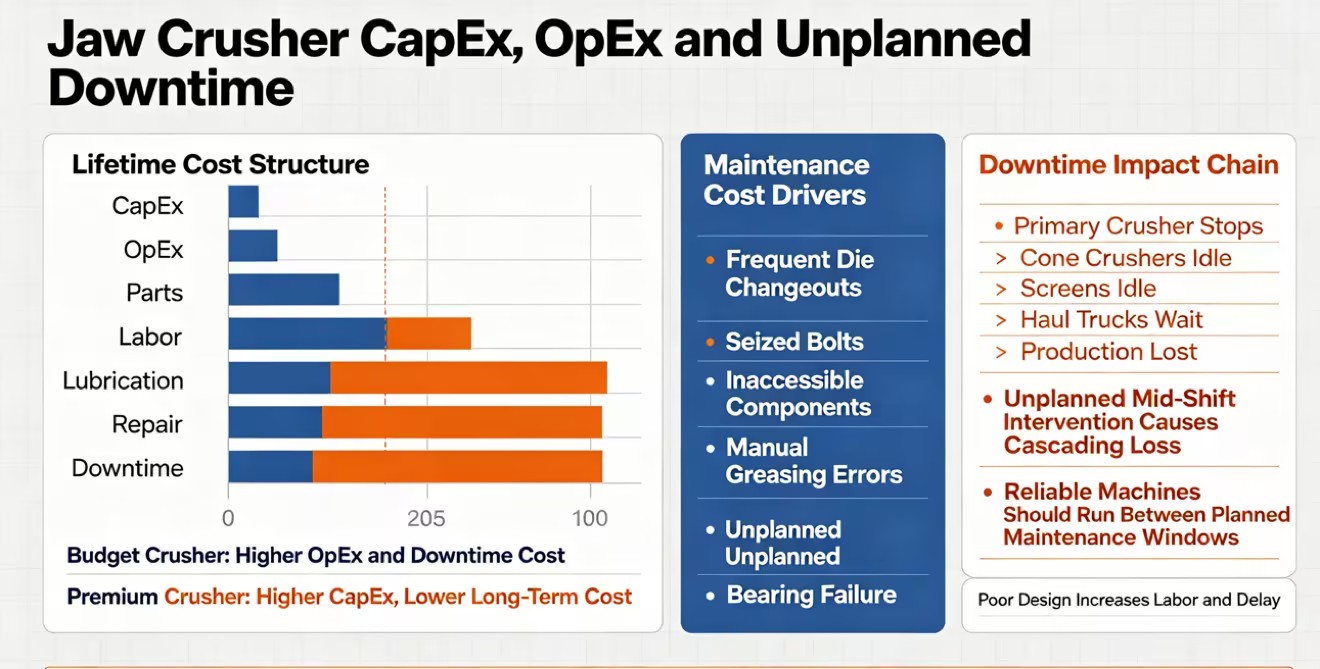
The initial purchase price of a primary crusher represents a mere fraction of its lifetime financial impact. Operating expenditure includes replacement parts, daily labor, lubrication, and structural repairs. These ongoing costs quickly surpass the initial capital outlay. Budget-tier crushers often look attractive on paper during the procurement phase. However, they frequently rely on inferior metallurgy and thinner frame constructions. This leads to accelerated structural fatigue. Frames crack under heavy loads. Welds fail under continuous vibration. When you buy a cheaper machine, you often pay the difference in repair bills and lost production within the first two years of operation. Heavy-duty frames built with stress-relieved steel absorb the kinetic energy of crushing without transferring that stress to the welds.
When a primary crusher stops, the entire plant stops. The financial impact cascades rapidly through the operation. You must evaluate maintenance by looking at these cascading costs. Acceptable maintenance intervals should align with planned plant shutdowns. If your crusher requires mid-shift intervention, it is failing your operation. A reliable machine runs continuously between scheduled preventative maintenance windows.
Downstream cone crushers and vibrating screens run empty, wasting electricity.
Haul trucks park in the pit, backing up the extraction process.
Wheel loaders sit idle at the surge pile.
Daily production quotas are missed, directly impacting revenue.
Standard maintenance tasks consume massive amounts of labor. Flipping a jaw die or replacing a toggle plate requires heavy lifting, rigging, and specialized tools. Older or poorly designed machines turn these routine tasks into multi-day projects. Seized bolts and inaccessible tension rods require cutting torches and extra mechanics. You must account for the hidden costs of this specialized labor. Every hour your mechanics spend fighting a poorly engineered chassis is an hour of lost production. Efficient designs allow a standard crew to perform wear part changeouts safely and quickly, utilizing engineered lifting points and clear access channels.
Modern crushing relies heavily on the single-toggle design. This configuration uses an eccentric shaft at the top of the swing jaw. It provides both the crushing force and the downward material movement. Single-toggle machines have fewer moving parts than older double-toggle designs. Fewer parts mean fewer failure points. The nip angle also plays a critical role in mechanical longevity. An optimized nip angle grabs rock efficiently without forcing it upward. This reduces unnecessary stress on the machine frame and the pitman. It also prevents violent rock ejections, protecting both the equipment and your operators from flying debris.
Bearings act as the heart of any crushing equipment. If a main bearing fails, you face a catastrophic breakdown that can sideline a plant for weeks. High-quality machines utilize oversized, heavy-duty spherical roller bearings. These bearings handle extreme radial and axial loads generated by breaking hard rock. However, even the best bearings fail without proper lubrication. Manual greasing introduces human error. Operators forget to grease, or they introduce dirt into the fittings. Automated, centralized lubrication systems eliminate this risk. They deliver precise amounts of clean grease at exact intervals. This single feature drastically extends bearing life and reduces daily maintenance hours.
Adjusting the closed side setting controls your output size and compensates for liner wear. Manual shimming is a brutal, time-consuming process. Operators must loosen tension rods, use hydraulic jacks or pry bars, and physically insert heavy steel shims. It exposes workers to pinch points and fatigue. Hydraulic CSS adjustment changes this entirely.
| Feature | Manual Shimming | Hydraulic CSS Adjustment |
|---|---|---|
| Time Required | 1 to 3 hours depending on access and seized bolts. | 2 to 5 minutes via push-button control. |
| Labor Intensity | High. Requires heavy lifting, pry bars, and multiple mechanics. | Low. Single operator from a control panel. |
| Tramp Relief | None. Chamber must be manually dug out if stalled. | Instant. Hydraulics open the jaw to drop uncrushable material. |
| Adjustment Frequency | Rarely done due to difficulty, leading to poor product sizing. | Done frequently, ensuring optimal downstream feed size. |
A machine is only easy to maintain if you can reach its components. Poorly designed crushers hide tension rods behind heavy guards or structural beams. They make toggle seat inspections nearly impossible. A well-engineered machine offers unobstructed access to the crushing chamber. It includes engineered lifting points for safe rigging. Integrated maintenance platforms allow mechanics to work at the correct height without balancing on ladders. When workers feel safe and have clear access, they perform maintenance tasks faster and more thoroughly. This directly translates to higher plant availability and lower labor costs.
Jaw dies endure extreme punishment. They rely on manganese steel, a unique alloy that work-hardens under impact. The base metal remains ductile, absorbing shock, while the surface becomes incredibly hard. Selecting the right alloy percentage dictates your maintenance intervals. You must match the metallurgy to your specific rock type. If you use the wrong alloy, the plates will either wear out prematurely or deform under pressure.
| Manganese Alloy | Characteristics | Best Application |
|---|---|---|
| 14% Manganese (Standard) | Good balance of impact resistance and initial hardness. Work-hardens quickly. | Soft to medium-hard rock, limestone, recycled concrete. |
| 18% Manganese (Premium) | Higher impact resistance. Takes longer to work-harden but achieves a higher final hardness. | Hard rock, granite, abrasive gravel, basalt, quartzite. |
| 22% Manganese (Extreme) | Maximum impact resistance. Very ductile initially. Requires extreme force to harden properly. | Extremely hard, large feed materials. Avoid in soft applications where it may deform. |
The shape of the jaw plate surface matters just as much as the metal itself. Corrugated profiles work well for standard aggregate, allowing fines to pass through the grooves without packing. Flat profiles provide massive surface area, making them ideal for highly abrasive materials that would quickly wear down sharp teeth. Sharp teeth excel at grabbing slippery, round river rock. Heavy-duty profiles feature thicker bases for extreme impact zones. Matching the tooth profile to your material prevents localized wear. It stops the rock from sliding against the die, which is the primary cause of rapid abrasion.
Wear in a crushing chamber is never uniform. The lower third of the jaw die does the majority of the final sizing. Therefore, it wears out much faster than the top section. Reversible jaw plates offer a massive cost advantage. Once the bottom section wears down, mechanics can flip the plate top to bottom. This exposes fresh teeth to the high-wear zone. Interchangeable plates take this a step further. You can swap the fixed die with the swing die if they share the same casting. This maximizes material utilization, ensuring you throw away less usable steel and stretch your maintenance budget further.
Choosing the wrong crusher type guarantees a maintenance nightmare. You must evaluate material hardness and abrasiveness using the Mohs scale and silica content analysis. Highly abrasive materials like granite, iron ore, and quartzite destroy impact crushers. The high-speed blow bars in an impactor suffer rapid abrasive wear, sometimes requiring replacement every few days. A Jaw Crusher operates differently. It uses compression force rather than high-velocity impact. The rock is squeezed between two plates. This limits the abrasive sliding action. For hard, abrasive rock, compression crushing is inherently lower maintenance.
Your production goals dictate your maintenance reality. Undersizing equipment is a common, costly mistake. Operators try to save money by buying a smaller machine and running it at maximum capacity. This overworks the motor, stresses the frame, and overheats the bearings. A machine running at 100% capacity will break down frequently. Properly sizing the equipment means buying a machine that hits your production targets while running at 75% to 80% capacity. This reduces structural fatigue. It extends liner life. It provides a buffer for unexpected surges in feed material without tripping the electrical breakers.
Every crusher has a maximum feed size, determined by its gape opening. Feeding rocks that exceed this limit causes bridging. The rock gets stuck at the top of the chamber. Bridging halts production instantly. Clearing a bridged rock is dangerous and time-consuming. It often requires heavy equipment to physically pull the rock out. Furthermore, oversized rocks place immense mechanical strain on the swing jaw before they finally break. Proper feed preparation prevents this. Using a vibrating grizzly feeder to scalp out oversized rocks and fines reduces unnecessary wear and keeps the chamber flowing smoothly.
Mobility introduces new maintenance variables. Track-mounted compact crushers offer incredible flexibility. You can move them directly to the rock face, reducing haulage costs. However, they package diesel engines, hydraulic drives, and crushing chambers into a tight space. This concentration increases vibration and heat. Hydraulic drives require strict fluid maintenance. Hoses chafe. Stationary electric plants offer simpler maintenance. They have massive concrete foundations that absorb vibration. Electric motors require less daily servicing than diesel engines. Yet, for smaller-scale or highly mobile operations, a well-maintained compact unit still offers excellent operational value provided the maintenance crew stays on top of filter changes and hydraulic inspections.
Equipment procurement involves balancing initial costs against long-term reliability. Premium machines feature heavy-duty, over-engineered frames. They use thicker steel plates and stress-relieved welds. This extra steel costs more upfront. However, it prevents the frame from flexing under load. Frame flex destroys bearings and cracks welds. Investing in a robust chassis pays off over a twenty-year lifespan. The savings realized through reduced structural fatigue and fewer catastrophic failures easily offset the higher initial purchase price.
Supply chain resilience directly impacts your maintenance costs. Some manufacturers design equipment that requires proprietary, single-source wear parts. If that manufacturer experiences a shortage, your plant shuts down. You lose leverage on pricing. Smart operators advocate for machines that utilize industry-standard components. Standardized bearings, belts, and toggle plates are available from multiple local vendors. This competition keeps replacement costs low. It ensures you can always find the parts you need to get back up and running quickly.
The balance of flywheel inertia and motor sizing impacts both electrical costs and mechanical stress. Massive flywheels store kinetic energy. When a hard rock enters the chamber, the flywheel releases this energy to power through the crush. This prevents the electric motor from experiencing massive amp spikes. It smooths out the peak loads on the drive belts and bearings. While heavier flywheels require more initial energy to spin up, they provide a much smoother, more efficient crushing cycle. This reduces mechanical stress on the entire drive system and extends the life of the electrical components.
Take the following actionable steps to optimize your next equipment acquisition and ensure maximum operational uptime:
Request detailed lifecycle cost analyses from equipment dealers, focusing on wear part consumption rates for your specific rock type.
Verify local parts availability and ensure the machine utilizes standardized bearings and drive components to avoid supply chain bottlenecks.
Conduct a thorough material hardness and abrasion test before finalizing procurement to ensure you select the correct manganese alloy and tooth profile.
Implement a meter-based preventative maintenance schedule and train your operators on the critical importance of feed size adherence.
A: Jaw crushers use compression force to break rock, squeezing it between two plates. This minimizes abrasive sliding. Impact crushers use high-speed blow bars to shatter rock. In hard, abrasive materials like granite, this high-velocity impact causes rapid, severe wear on the blow bars, requiring frequent and costly replacements.
A: Lifespan varies entirely based on material abrasiveness and crusher settings. In soft limestone, manganese dies can last over a year. In highly abrasive quartzite, they may wear out in a few weeks. Proper alloy selection and flipping the plates strategically will maximize their usable lifespan.
A: Main bearings and pitman bearings typically require daily lubrication to flush out contaminants and maintain a protective film. Automated lubrication systems are highly recommended, as they provide continuous, precise amounts of grease, eliminating the risks associated with missed manual greasing intervals.
A: Premature wear is usually caused by operating outside design parameters. Feeding oversized rocks causes bridging and uneven stress. Running the machine at a closed side setting tighter than the manufacturer recommends overloads the bearings. Failing to maintain proper tension on the toggle plate also accelerates wear.
A: Yes. Hydraulic systems allow for push-button adjustment of the closed side setting, eliminating the dangerous and time-consuming process of manually inserting heavy steel shims. Hydraulics also provide rapid tramp relief, allowing operators to clear stalled chambers quickly without manually digging out rock.
A: Never send personnel into a jammed chamber. If equipped, use the hydraulic tramp relief to open the jaw and let the material pass. If mechanical, follow strict lock-out/tag-out procedures, secure the swing jaw, and use heavy equipment with rigging hooks to pull the bridged material out from the top.
A: Yes, compact units can crush granite if equipped with the correct heavy-duty manganese dies. However, you must strictly monitor feed size and avoid overloading the smaller hydraulic and cooling systems. Frequent maintenance checks on the track drives and engine filters are also necessary in dusty environments.


