- All
- Product Name
- Product Keyword
- Product Model
- Product Summary
- Product Description
- Multi Field Search


Views: 0 Author: Site Editor Publish Time: 2026-09-18 Origin: Site


Primary crushing dictates the rhythm and profitability of an entire quarry operation. An under-specced machine creates severe downstream bottlenecks, while an over-specced unit inflates capital and operational expenditures unnecessarily. Quarry operators process high-compressive-strength rock like granite, basalt, and quartzite. They must handle massive volumes efficiently while strictly controlling wear-part costs, energy consumption, and unplanned downtime. This analysis breaks down a real-world Jaw Crusher Project Case. We detail the technical evaluation, implementation realities, and measurable outcomes of deploying a heavy-duty Jaw Crusher in a high-yield quarry environment. Proper primary sizing prevents downstream failures and maximizes long-term operational efficiency. This study provides actionable field data for optimizing your primary reduction stage.
Primary Crushing Efficiency: Properly sizing the jaw crusher to the blast yield reduces secondary crushing loads, directly lowering overall energy consumption per ton.
Wear Part Economics: Analyzing the abrasion index of the feed material is critical; optimizing toggle kinematics and jaw plate metallurgy can extend wear life by up to 30% in hard-rock applications.
Integration Dependencies: A successful deployment relies heavily on synchronized feeder rates and conveyor capacities to prevent bridging and ensure continuous throughput.
OpEx over CapEx: Initial equipment costs are secondary to long-term operational expenditures (OpEx), specifically regarding maintenance downtime and power draw.
Output Shape Dynamics: Jaw crushers are built for volume reduction, not shaping; achieving final product specifications requires strategic pairing with secondary and tertiary crushing stages.
Defining specific operational parameters establishes the baseline for any plant design. This project targeted a processing rate of 800 tons per hour (TPH). The annual production quota was set at 2.5 million tons. The geological profile featured hard granite extracted from a deep-bench advancing face. Core sample testing revealed an unconfined compressive strength (UCS) of 180 MPa. Moisture content remained below two percent year-round. The silica content exceeded 65%, driving an exceptionally high abrasion index. These geological factors dictated a robust primary reduction strategy.
The success criteria demanded a consistent 4:1 reduction ratio from the primary station. Operators required a low percentage of fines generated at this initial stage. Generating excess fines wastes energy and complicates downstream screening. The ultimate target was achieving the lowest possible operating cost-per-ton without sacrificing the 800 TPH throughput. Establishing these metrics prevents subjective equipment selection. The 180 MPa rock hardness eliminates lighter-duty crushing alternatives immediately. High abrasion index values directly impact the maintenance budget, as wear parts degrade rapidly under these conditions.
The previous setup utilized an undersized primary unit. This created severe operational limitations across the entire plant. The gape was simply too small for the blast fragmentation profile. Operators frequently halted production to clear bridged rocks from the chamber. An excavator equipped with a hydraulic breaker sat permanently over the dump hopper. This represented a massive waste of diesel and labor just to feed the plant. Oversized feed routinely slipped past the primary stage due to worn dies and an improperly maintained closed side setting (CSS).
This oversized material reached the secondary cone crushers. Cone crushers are not designed for primary reduction tasks. When oversized slabs hit the cone, they caused severe ring bounce and accelerated wear on the manganese liners. Frequent stalling events disrupted daily production schedules. Power spikes tripped electrical breakers and halted the entire circuit. The compromised feed size also ruined the final aggregate shape. Cone crushers require a choke-fed, consistently sized input to produce cubical aggregate. Erratic primary output prevents choke feeding, leading to slabby, out-of-spec final products. The undersized primary unit effectively choked the entire operation.
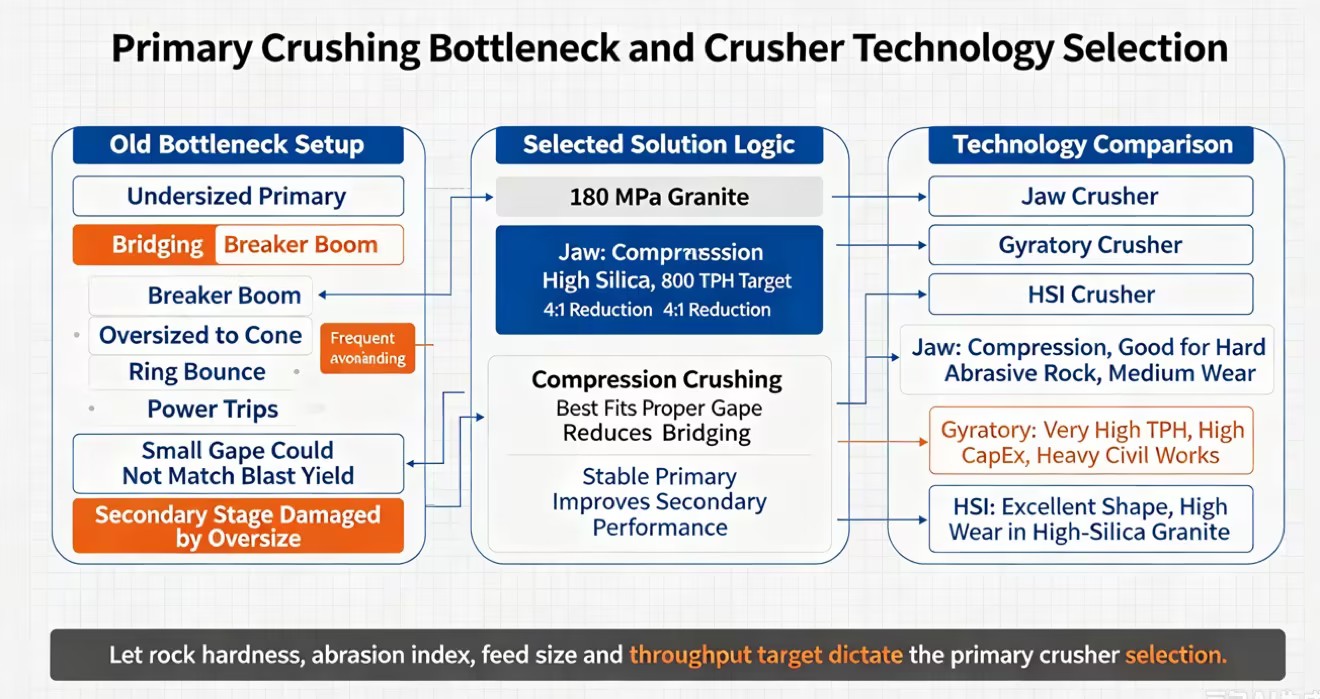
Evaluating compression mechanics against alternative primary methods requires looking at the specific rock data. Horizontal Shaft Impact (HSI) crushers offer excellent cubical shape. They use high-speed rotors and blow bars to shatter rock along natural fault lines. However, they suffer prohibitive wear costs when processing highly abrasive granite. The 65% silica content destroys blow bars in a matter of days. Gyratory crushers deliver massive, continuous throughput. They are ideal for operations exceeding 2000 TPH. Yet, they require significantly higher capital expenditures and demand massive, complex civil foundations.
A heavy-duty compression chamber provides the ideal balance for this 800 TPH granite application. Compression crushing uses immense mechanical leverage to fracture hard rock. It forces the material between a fixed steel plate and a moving pitman. We acknowledge the rough, angular output typical of this method. The rock often fractures into slabby pieces. The primary role here is strictly volume reduction. The system relies entirely on secondary cone crushers for final aggregate shaping. By accepting a rougher primary output, the operation saves massively on wear costs.
| Crusher Type | Primary Mechanism | Best Application | Wear Cost in Hard Rock | Output Shape |
|---|---|---|---|---|
| Jaw | Compression | Hard, abrasive rock (Medium-High TPH) | Low to Moderate | Rough, Angular, Slabby |
| Gyratory | Compression | Hard, abrasive rock (Very High TPH) | Low | Rough, Angular |
| Horizontal Impact (HSI) | Impact / Cleavage | Soft to medium rock, low abrasion | Extremely High | Excellent, Cubical |
The crushing chamber geometry dictates overall performance. The relationship between the gape and the closed side setting (CSS) requires precise alignment. The gape is the rectangular feed opening at the top of the chamber. The maximum feed size from the muck pile must fit easily into this opening. A standard field rule dictates the maximum rock size should not exceed 80% of the gape depth. This prevents bridging and material hang-ups. For this project, blast fragmentation analysis dictated a minimum gape of 42 by 48 inches. This accommodated the largest boulders without requiring secondary rock breaking at the hopper.
Engineers evaluate the nip angle carefully during selection. The nip angle is the angle between the fixed and moving plates. A proper nip angle prevents material slippage during the compression stroke. If the angle is too wide, hard round rocks will shoot upward. This phenomenon is known as "boiling." Boiling halts throughput, damages overhead equipment, and creates severe safety hazards for site personnel. A narrower nip angle ensures the rock is gripped firmly. It forces the material downward through the chamber. Aligning the gape, CSS, and nip angle guarantees the machine meets the 800 TPH target consistently.
High-inertia flywheel startups demand robust electrical infrastructure. The massive steel flywheels require immense torque to begin rotating from a dead stop. We assess the peak electrical draw during motor initiation. This peak draw can easily hit three times the running current. The site must have adequate transformer capacity to handle this spike without browning out other plant sectors. Soft starters or variable frequency drives (VFDs) mitigate these massive power surges. They ramp up the motor speed gradually, protecting the local power grid and extending the lifespan of the drive belts and motor windings.
Operators must choose between diesel-hydraulic and direct electric drive systems. Direct electric drives offer lower operating costs. They are highly efficient and require less maintenance than diesel engines. However, they rely entirely on grid stability. Diesel-hydraulic systems provide complete independence. They are ideal for remote site locations lacking robust utility power. For this specific project, the quarry had access to reliable, high-voltage utility power. The direct electric drive was selected to minimize long-term energy expenditures. Fuel costs, local power availability, and environmental emission regulations drive this final engineering decision.
Quarries with advancing faces often debate stationary versus tracked mobile units. Traditional stationary setups require a centralized processing plant. Haul trucks must transport blasted rock over increasing distances as the quarry expands. This increases load-and-carry haulage costs significantly over the life of the mine. Tracked mobile units move directly with the blast face. Excavators load them directly at the muck pile. This mobility drastically reduces diesel consumption for haul trucks and reduces the required truck fleet size.
Mobile units have distinct mechanical limitations. They generally feature smaller gapes and lower maximum throughputs compared to massive stationary units. Maintenance access is often tighter on mobile chassis, complicating routine liner changes. For this specific project case, operational flexibility favored a modular stationary setup. The quarry layout allowed for a highly efficient, centralized haul road network. The 800 TPH requirement exceeded the optimal continuous capacity of standard tracked units. The stationary configuration allowed for a massive 150-ton feed hopper and heavier, more durable cast steel components.
Stationary units demand rigorous civil engineering and site preparation. The physical realities of installation involve managing massive dynamic loads. The crushing action generates severe vertical and horizontal forces that transfer directly into the ground. Vibration isolation is a mandatory design element. Engineers must construct heavily reinforced concrete structures. The concrete must cure fully to achieve maximum compressive strength before the equipment is set. Improper foundations lead to structural cracking, bearing failure, and catastrophic equipment misalignment.
Heavy-duty modular skids offer faster deployment alternatives. These steel structures bolt together on-site. They require less concrete work than traditional poured foundations. Modular skids still require a compacted, leveled sub-base. They distribute the dynamic loads across a wider footprint. For this project, a hybrid approach was utilized. Deep concrete piers supported a heavy-duty steel modular skid. High-strength epoxy grout was poured under the base frame to ensure 100% contact and vibration dampening. This ensured structural integrity during peak crushing loads while accelerating the overall installation timeline.
Integration relies heavily on vibrating grizzly feeders (VGF). These feeders sit directly below the dump hopper. They perform two critical functions. First, they meter the rock into the crushing chamber at a consistent rate, preventing flood feeding. Second, they scalp fines and undersized material before the chamber. The grizzly bars allow smaller rocks and dirt to fall through to a bypass chute. Scalping prevents chamber packing. It eliminates unnecessary wear on the steel dies. Crushing rock that is already small enough wastes massive amounts of energy and reduces overall plant capacity.
Discharge conveyors require precise calibration. The belt sits directly beneath the crushing chamber. It must handle sudden surge loads without stalling. When a massive boulder fractures, a surge of material drops instantly onto the belt. The conveyor motor must have sufficient torque to pull this load. Skirting and heavy-duty impact beds prevent material spillage and belt damage. Proper synchronization between the feeder, the chamber, and the discharge belt prevents bottlenecks. It maintains a continuous, highly profitable production loop.
Initial deployment faces several common mechanical failures if not managed correctly. Improper CSS calibration easily leads to downstream bottlenecks. If the CSS is set too wide, oversized rock floods the secondary circuit. If set too tight, the primary chamber backs up and production halts. Inadequate toggle plate alignment causes premature mechanical wear. The toggle plate acts as a safety fuse. If misaligned, it will not protect the pitman during a tramp metal event. We outline strict testing protocols to prevent these issues.
Verify eccentric shaft rotation direction to ensure material is pulled downward.
Torque all foundation anchor bolts to manufacturer specifications.
Calibrate the vibrating grizzly feeder stroke and speed.
Execute an empty-chamber run to monitor baseline vibration and bearing temperatures.
Conduct partial load testing to verify nip angle effectiveness and material flow.
Perform full-capacity surge tests while monitoring electrical draw.
Post-implementation data reveals significant operational gains. The actual TPH achieved consistently matched the theoretical capacity. The plant sustained 800 TPH during peak operating hours without tripping breakers. The discharge gradation remained highly consistent. This consistency directly improved the efficiency of the secondary crushing stage. The cone crushers received a steady diet of properly sized rock. This allowed them to operate at optimal choke-fed conditions. The entire plant rhythm stabilized, eliminating the erratic stop-and-go production of the past.
The required 4:1 reduction ratio was maintained effortlessly. The massive flywheels provided sufficient kinetic energy to fracture the 180 MPa granite. The drive motor did not experience thermal overload during surge events. The nip angle proved effective, with zero reported instances of material boiling. The integration of the vibrating grizzly feeder successfully bypassed 15% of the feed. This further increased the effective capacity of the primary circuit. The throughput achievements validated the initial engineering calculations and justified the equipment sizing.
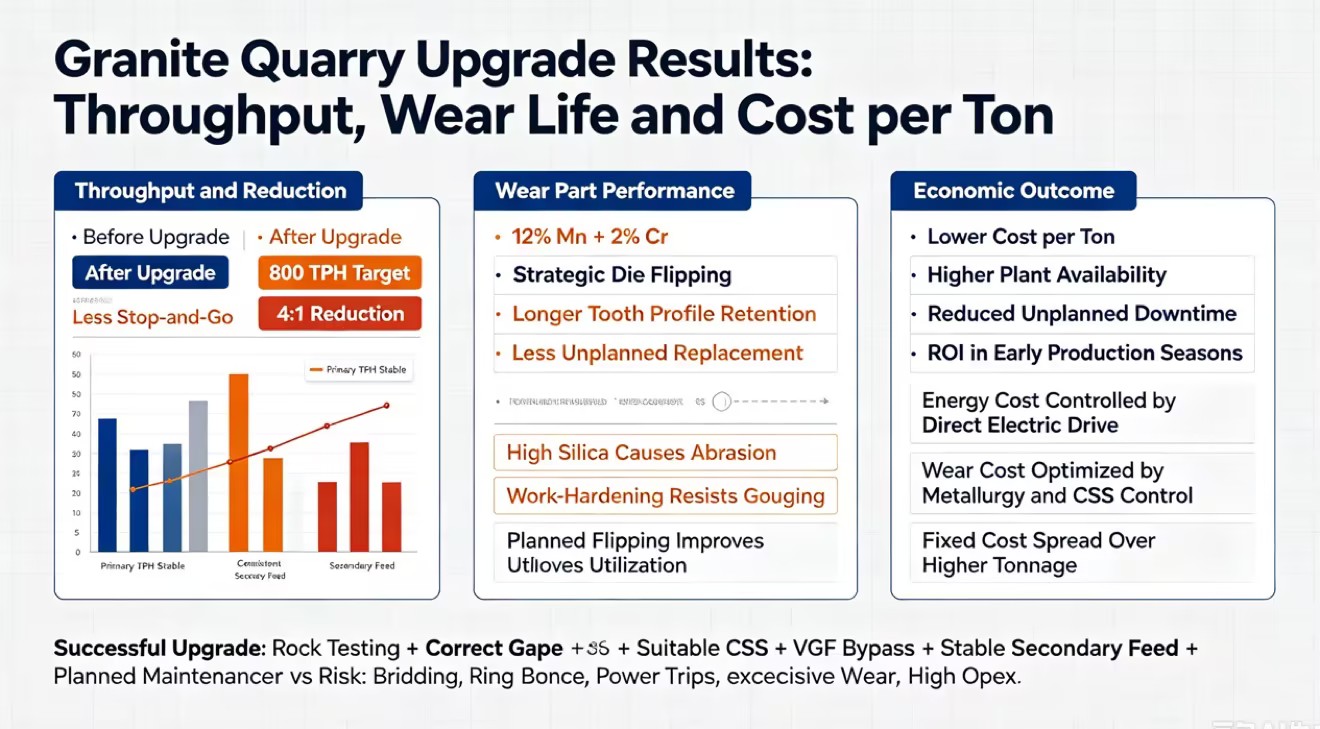
Manganese steel dies perform the heavy lifting in this environment. We reviewed the performance of both fixed and movable plates. The quarry utilized 18% manganese steel with a 2% chromium addition. This specific metallurgy hardens under impact. The actual wear life in operating hours exceeded initial manufacturer predictions. The high silica content of the granite caused expected abrasion. The work-hardening properties of the manganese resisted premature gouging, maintaining the tooth profile longer than standard carbon steel.
We implemented strict efficiency optimization tactics. Strategic flipping of the dies maximized wear life. The lower portion of the plates wears much faster than the top due to the tighter crushing clearance. Technicians scheduled maintenance shutdowns to flip the plates end-for-end. This practice maintained a consistent closed side setting. It also ensured maximum utilization of the expensive manganese steel. Regular inspection of the toggle seat, tension rod, and cheek plates prevented secondary mechanical failures. These routines reduced overall replacement frequency and kept maintenance costs predictable.
Calculating the true operating cost-per-ton requires comprehensive data collection. We factor in energy consumption, wear part replacement costs, and maintenance labor. The direct electric drive system minimized energy costs compared to diesel alternatives. The extended wear life of the manganese plates reduced consumable expenses. The increased production capacity distributed fixed plant costs over a larger tonnage. This significantly lowered the baseline cost-per-ton, making the quarry more competitive in the local aggregate market.
Reduced unplanned downtime further improved the financial metrics. The previous undersized setup suffered weekly stalling events and broken excavator breakers. The new heavy-duty installation operated for months without unscheduled interruptions. This reliability allowed the sales team to commit to larger aggregate supply contracts with highway contractors. The operational economics proved highly favorable. The initial capital expenditure was justified by the massive reduction in daily operating costs. The plant achieved a rapid return on investment within the first two production seasons.
Operators need a rigid framework to test their own rock. Visual inspection is never sufficient for equipment selection. Using metrics like the Bond Work Index determines crushing resistance. Laboratory testing must establish the exact unconfined compressive strength in MPa. Highly abrasive rock with high compressive strength mandates heavy-duty compression equipment. Granite, quartzite, and hard basalt fall into this category. The silica content dictates the abrasion index and drives the metallurgy selection for the wear liners.
Softer, less abrasive materials might allow for alternative methods. Limestone or dolomite often possess lower compressive strengths. In these softer applications, horizontal impact crushers might be viable primary units. They offer better initial shaping and can sometimes eliminate a secondary crushing stage entirely. Applying an impactor to 180 MPa granite guarantees financial ruin through wear costs. Accurate geological testing prevents catastrophic equipment mismatches. Let the rock dictate the machine.
Equipment selection involves balancing initial costs against long-term expenses. Investing in premium features often makes financial sense over a ten-year lifespan. Hydraulic CSS adjustment is a prime example. Standard mechanical setups require manual shimming to adjust the CSS. This takes hours of labor, requires heavy lifting, and halts production. Hydraulic systems adjust the CSS in minutes via a push-button interface. This reduces maintenance downtime and encourages operators to maintain optimal settings daily.
Automated tramp iron relief protects the chamber from catastrophic damage. If an excavator tooth enters the chamber, mechanical toggle plates must break to save the pitman and eccentric shaft. Replacing a broken toggle plate halts production for a full shift. Hydraulic relief systems open the chamber automatically to pass the uncrushable object. They then reset to the original CSS immediately. Standard mechanical setups cost less upfront. They incur significantly higher labor costs and downtime penalties over time.
A quarry operation rarely remains static over its lifespan. The selected equipment must accommodate future expansion plans. It should handle inevitable changes in blast profiles. As the quarry deepens, rock characteristics often change. Deeper benches usually yield harder, more competent rock. The primary crusher must possess enough structural overhead to handle harder rock strata. Shifts in final product demand require flexible primary reduction. A properly sized primary chamber ensures the plant can scale without replacing the most expensive asset.
If market demand requires increasing plant output to 1000 TPH, the primary unit must not become the bottleneck. Oversizing the primary gape slightly during the initial build is a standard future-proofing tactic. It allows for larger blast patterns, reducing drilling and blasting costs. It also ensures the primary circuit can feed additional secondary crushers if the plant expands. Strategic scalability protects the initial capital investment for decades and provides operational flexibility.
The heavy-duty compression setup proved technically sound and economically viable for this specific granite quarry. It perfectly balanced the required reduction ratio with highly manageable wear costs. The robust design eliminated downstream bottlenecks and stabilized the entire plant rhythm. Quarry managers must evaluate primary crushers based on maximum feed size, rock hardness, TPH requirements, and downstream integration. Ignoring any of these variables leads to operational failure. To optimize your own primary circuit, follow these actionable steps:
Conduct a comprehensive site audit to identify current primary bottlenecks and power draw spikes.
Analyze your latest blast fragmentation data to determine the absolute minimum gape size required.
Test your rock core samples for compressive strength (MPa) and silica-driven abrasion index.
Consult with application engineers to project long-term operating costs based on specific metallurgy.
Implement rigorous, scheduled maintenance routines for wear part flipping and CSS calibration.
A: The standard reduction ratio ranges from 3:1 to 6:1. The Closed Side Setting (CSS) and the maximum feed size dictate this ratio. Pushing beyond a 6:1 ratio causes excessive wear, chamber packing, and severe mechanical stress on the pitman and bearings.
A: No. They produce rough, angular, and often slabby material. They operate via pure compression, which fractures rock along unpredictable lines. They are strictly for primary volume reduction and must be paired with secondary or tertiary crushers to achieve cubical aggregate shapes.
A: High compressive strength and high silica content rapidly degrade manganese steel plates. Highly abrasive rock requires specific metallurgical selections, such as 18% or 22% manganese with chromium additions. It also mandates strict maintenance routines, like strategic die flipping, to maximize wear life.
A: While typically used for primary reduction, smaller units can act as secondary crushers. This occurs in specific low-capacity operations or highly abrasive applications where cone crushers are not economically viable due to extreme liner wear.
A: The primary culprits include high moisture or clay content causing material packing. Oversized feed exceeding the gape dimensions causes bridging. Inadequate fines scalping by the grizzly feeder prior to the chamber also leads to severe plugging and stalling.
A: You calculate this by adding annualized capital expenditures, annual energy costs, wear part replacement costs, and maintenance labor. Divide this total sum by the total annual tonnage produced. This reveals the true financial efficiency of the crushing circuit.
A: Single-toggle designs feature a complex elliptical motion that forces material down, offering higher throughput. Double-toggle designs utilize a pure crushing motion with massive mechanical leverage. Double-toggles are built for extreme durability in the hardest rock but generally offer lower throughput capacities.


