- All
- Product Name
- Product Keyword
- Product Model
- Product Summary
- Product Description
- Multi Field Search


Views: 0 Author: Site Editor Publish Time: 2026-09-18 Origin: Site


Operating heavy crushing equipment involves extreme kinetic energy, immense mechanical force, and severe environmental hazards. Industrial material processing carries high stakes. Plant managers must treat Jaw Crusher Safety not just as a compliance requirement, but as a critical operational metric. Incidents related to bridged rock, projectile material, exposed moving parts, or maintenance errors carry massive consequences. They lead to severe personnel injury, costly unplanned downtime, and significant liability exposure. Basic regulatory compliance is no longer sufficient for modern quarry and mining operations. Facilities must move toward a proactive evaluation of their safety protocols. This requires implementing modern equipment upgrades and standardizing risk mitigation frameworks. By understanding the mechanical realities of the crushing chamber, operators can eneer hazards out of the process entirely. We must prioritize automation, strict access control, and rigorous maintenance standards to protect personnel and maintain continuous production.
Feed Control is Risk Control: Matching raw material size to the jaw opening and preventing chamber overloading are the primary preventative measures against high-risk blockage incidents.
Zero-Platform Operation: Modern safety standards dictate that no personnel should be present on the crusher access platform during normal crushing operations.
Automation Over Manual Intervention: Upgrading to hydraulic clearing systems and remote monitoring significantly reduces the need for dangerous manual blockage clearing.
Strict LOTO Enforcement: Non-negotiable Lockout/Tagout (LOTO) procedures during wear part replacement and routine maintenance are the baseline for preventing catastrophic startup accidents.
Investing in comprehensive safety protocols delivers measurable returns to the operation. Safety directly influences production efficiency and financial stability. You cannot separate a safe site from a productive site. When operators feel secure in their environment, equipment utilization rates stabilize, and maintenance schedules become predictable.
Capital allocated to safety features and rigorous training generates a distinct return on investment. This investment directly reduces your Total Recordable Incident Rates (TRIR). A lower TRIR improves your standing with regulatory bodies and insurance providers. Operations with documented, proactive safety measures often negotiate significantly lower insurance premiums. Preventing a single catastrophic injury saves hundreds of thousands of dollars in direct medical costs, legal fees, and regulatory fines. Safety upgrades pay for themselves by keeping your workforce intact and your facility operational. You also avoid the hidden costs of replacing skilled operators who leave due to unsafe working conditions.
Operators sometimes bypass safety protocols to maintain high throughput. This is a dangerous false economy. Clearing a jammed chamber manually might save twenty minutes today. If that action causes an injury, the resulting downtime is devastating. An accident investigation halts production for days or weeks. The compounding costs of halted production, site audits, and equipment impoundment dwarf any short-term throughput gains. True operational efficiency requires predictable, uninterrupted processing. You achieve this predictability only through strict adherence to safe operating procedures. Pushing a machine beyond its safe feed capacity inevitably leads to bridging, which stops production entirely.
Regulatory bodies like MSHA, OSHA, and the HSE enforce strict baselines for machinery operation. You must understand and exceed these core expectations. Regulators mandate comprehensive machinery guarding around all moving parts. They strictly govern platform access during operation. Hazard communication must be clear, visible, and universally understood by all site personnel. Failing to meet these baselines triggers immediate citations and stop-work orders. Treat these regulations as the absolute minimum standard. Your internal protocols should aim much higher to ensure genuine operational resilience.
To establish a robust compliance baseline, operations managers must enforce the following standards:
Conduct documented weekly audits of all physical machinery guards, ensuring no bolts are missing and no mesh is compromised.
Maintain updated hazard communication signage at all access stairs and control rooms, specifically detailing pinch points and high-voltage areas.
Verify that all operators hold current, site-specific training certifications for the exact model of equipment they are running.
Implement a digital logging system for all pre-shift inspections to ensure accountability and track recurring maintenance issues.
Understanding specific hazard categories allows you to deploy targeted mitigation strategies. Every crushing circuit presents unique environmental and mechanical challenges. Identifying the root cause of these hazards is the first step in engineering them out of your daily workflow.
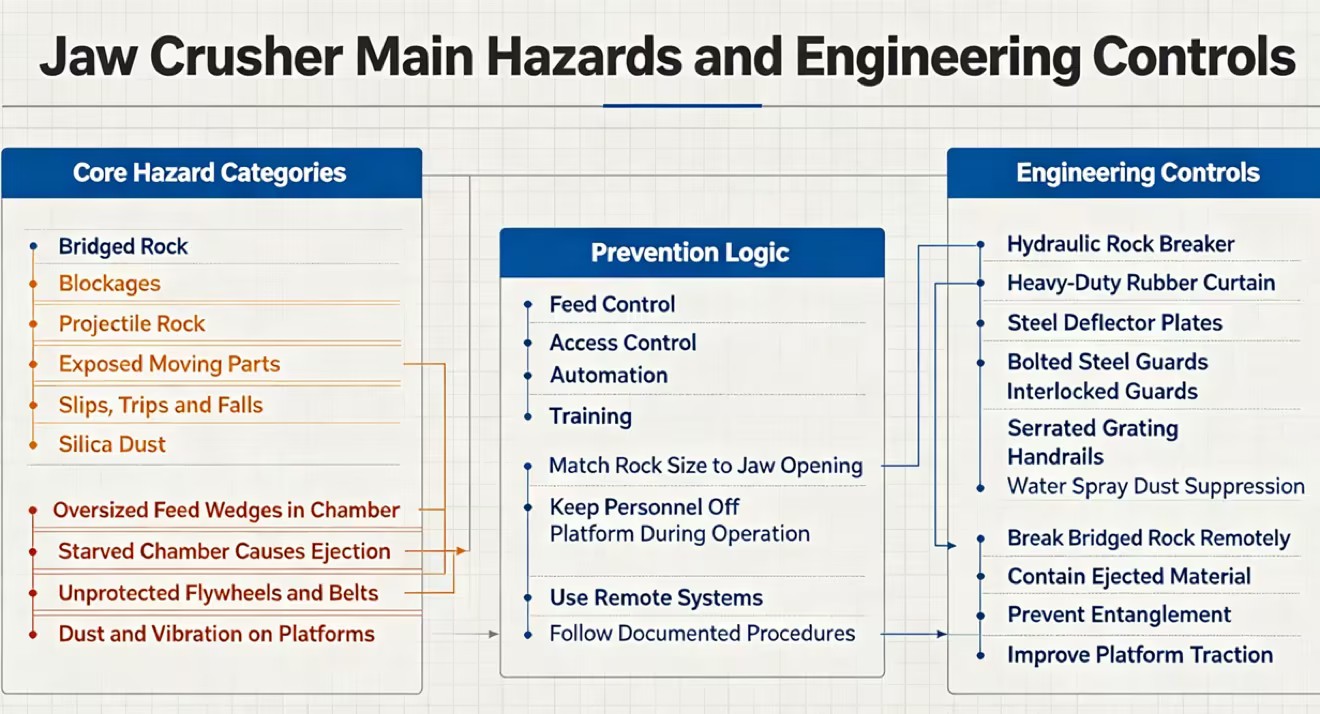
Bridged rock occurs when oversized material wedges inside the crushing chamber. The rock forms an arch against the stationary and moving jaw dies. This stops material flow completely. Overloading the feed exacerbates this issue. When operators dump too much material into the chamber at once, rocks interlock. They cannot flow down into the crushing zone. The immense pressure from the material above locks the bridged rocks tightly in place.
You must implement strict preventative strategies to avoid blockages. First, optimize your blasting procedures at the quarry face. Better fragmentation reduces the number of oversized rocks reaching the primary crusher. Second, implement strict feed size limits. Match the maximum rock size to your specific jaw opening, typically keeping top size to 80% of the gape. Finally, install mechanical rock breakers alongside the feed hopper. A hydraulic boom allows operators to break bridged rocks remotely. This eliminates the need for personnel to approach the open chamber.
A Jaw Crusher applies immense compressive force. Occasionally, this force causes material to eject upward out of the chamber. This happens when rocks are too round, too hard, or when the chamber is starved of material. Without a continuous flow of rock to weigh down the material below, the upward force of the crushing action can shoot rocks into the air with lethal velocity.
Mitigating projectile rock requires physical barriers and operational adjustments. Install heavy-duty rubber curtains above the feed opening. These curtains absorb the kinetic energy of flying rocks. Mount steel deflector plates to direct any ejected material back into the hopper. Operationally, strive to choke-feed the equipment. Keeping the chamber adequately full prevents individual rocks from bouncing freely. The weight of the overlying material keeps the crushing action contained deep within the chamber.
Crushing equipment relies on massive rotating components. Exposed flywheels, high-tension drive belts, and heavy toggle mechanisms present severe entanglement risks. Pinch points can easily sever limbs or cause fatal crush injuries. Personnel working near the machine are constantly at risk if these components remain exposed during operation or maintenance testing.
You must establish and enforce strict physical guarding standards. Every moving part must feature a robust steel guard. Ensure all guards are securely bolted in place. Quick-release latches are often insufficient for heavy vibration environments. Where applicable, utilize interlocked guards. These electronic systems prevent the machine from starting if a guard is removed. Never energize the equipment until every single guard is verified secure by the shift supervisor.
The environmental realities of a crushing plant are harsh. Thick dust coats every surface. Heavy vibration shakes platforms and walkways. Rain and snow create slick conditions. These factors make slips, trips, and falls a leading cause of injury around crushing circuits. A fall from a primary crusher platform often results in severe trauma due to the height and the presence of jagged steel below.
Establish rigorous standards for all access points. Install high-grip, serrated grating on all walkways. Smooth steel plates are unacceptable. Ensure handrails are secure, structurally sound, and meet height regulations. Strictly prohibit climbing on the crusher frame. Personnel must only use designated access platforms and ladders. If a component is out of reach, use certified man-lifts or scaffolding.
| Hazard Category | Primary Mechanical Cause | Engineered Mitigation Strategy | Operational Protocol |
|---|---|---|---|
| Bridged Rock | Oversized feed material exceeding gape capacity | Hydraulic rock breaker booms mounted at the feed | Optimize blasting fragmentation and enforce top-size limits |
| Projectile Material | Starved chamber allowing upward kinetic transfer | Heavy-duty rubber curtains and steel deflector plates | Maintain consistent choke-feeding to suppress ejection |
| Entanglement | Exposed flywheels, v-belts, and toggle plates | Bolted steel guards with electronic safety interlocks | Mandatory pre-operation visual inspections of all guards |
| Slips and Falls | Dust accumulation, vibration, and weather conditions | Serrated steel grating and reinforced handrails | Strict prohibition of climbing on machine frames |
| Silica Exposure | Crushing action generating respirable crystalline dust | High-pressure water sprays and dust encapsulation | Mandatory use of sealed, positive-pressure operator cabs |
Modern equipment design prioritizes operator safety. Upgrading your machinery introduces features that remove personnel from the line of fire. Relying on outdated equipment forces your team to take unnecessary physical risks during routine adjustments and blockage clearing.
Legacy machines rely on manual toggle adjustments. Operators use heavy tools to add or remove metal shims to change the Closed Side Setting (CSS). This process is physically demanding and places workers near dangerous pinch points. Modern hydraulic CSS adjustments eliminate this risk. Operators change the setting via a control panel, using hydraulic cylinders to move the jaw safely and precisely.
Evaluate the safety outcomes of hydraulic tramp iron relief systems. If an uncrushable object, like a loader tooth or excavator bucket lip, enters the chamber, manual machines often suffer catastrophic failure. The toggle plate shatters, sending shrapnel outward. Hydraulic systems automatically detect the pressure spike. The cylinders open the jaw, allowing the tramp iron to pass safely. The system then resets automatically. This prevents mechanical explosions and eliminates the need to manually dig out jammed steel.
Operators monitoring the feed need protection from noise, dust, and projectiles. Assess the requirements for safe operator enclosures carefully. A safe cab requires heavy-duty sealing to keep out particulate matter. It needs reinforced door jambs and proper joints to withstand constant vibration. You must use shatter-resistant window grooves to protect against flying rock. Standard glass will fail under the impact of a high-velocity ejected stone.
Environmental controls inside the cab are equally critical. You must implement positive pressure ventilation. This system pumps clean air into the cab, preventing outside dust from seeping in through micro-cracks. Integrate HEPA air filtration to mitigate exposure to respirable crystalline silica. Silica dust causes severe, irreversible respiratory illnesses like silicosis. A properly sealed and filtered cab is a non-negotiable safety requirement for stationary operators working near the primary feed.
Automation keeps workers out of hazardous zones. Evaluate the implementation of remote control systems. These systems allow operators to manage feed rates, adjust settings, and clear blockages from a safe distance. A worker with a belly-pack remote can operate a rock breaker from a secure vantage point, far from the crushing chamber and potential projectile paths.
Integrating telemetry into your plant-wide SCADA systems enhances safety through predictive maintenance. Sensors monitor bearing temperatures, vibration levels, and hydraulic pressure. This data allows you to schedule repairs before a component fails catastrophically. Predictive maintenance prevents the sudden, dangerous breakdowns that often lead to rushed, unsafe repair attempts in the middle of a production shift. When maintenance is planned, safety protocols are followed much more rigorously.
Blockages will eventually occur despite best efforts. How your team responds to these blockages determines your safety record. A panicked, rushed response to a jammed chamber usually results in severe injury.
We must explicitly state the severe risks of manual intervention. Never use pry bars, wedges, or manual force to dislodge bridged rock. A bridged rock holds immense stored kinetic energy. The rocks are wedged under thousands of pounds of pressure. If a worker dislodges the keystone rock manually, the entire mass shifts instantly. The sudden movement can crush tools, trap limbs, or pull a worker into the chamber. Manual unblocking is a leading cause of fatal accidents in crushing operations. There is no safe way to manually pry a rock loose from an active crushing zone.
You must implement a step-by-step framework for safe clearing. Relying on operator intuition is unacceptable. Follow a strict, documented procedure every time the chamber bridges.
Halt the vibrating grizzly feeder immediately to prevent any additional material from entering the jammed chamber.
Alert the control room and sound the local alarm to clear all non-essential personnel from the primary crushing station.
Utilize the mechanical rock breaker boom to fracture the bridged material from a safe distance, targeting the keystone rock.
If a mechanical breaker is unavailable, initiate full Lockout/Tagout procedures before approaching the machine.
Use specialized hydraulic wedges or expansive demolition grout to break the rock. Never use manual sledgehammers or pry bars.
Safely secure the toggle plate and block the flywheel before any personnel look directly into the chamber to inspect the cleared blockage.
Reinforce the strict "Zero-Platform" guideline. Health and Safety Executive (HSE) standards dictate that mobile and stationary crushing operations must be designed safely. Personnel are never required on the access platform while the machine is energized. If an operator needs to inspect the chamber, they must shut down the machine first. Design your walkways and inspection points so that routine checks happen from ground level or from shielded, remote platforms. If a worker is on the platform, the machine must be off. No exceptions.
Routine maintenance introduces significant risks. Workers interact with heavy components, high-pressure hydraulics, and high-voltage electricity. The transition from operation to maintenance is when many accidents occur due to poor communication and inadequate isolation.
Safety begins before the machine starts. Detail the necessity of daily walkarounds. Operators must inspect the machine for structural wear and tear. Look for hairline cracks in the frame or pitman. Check for loose components, missing bolts, and leaking hydraulic lines. Verify that all guards are uncompromised and securely fastened. You must complete this comprehensive checklist before initiating any startup sequences. Catching a loose bolt during a walkaround prevents a catastrophic failure during operation. Document these inspections digitally to track wear trends over time.
Detail a comprehensive LOTO framework specific to crushing equipment. LOTO is not just flipping a switch. It requires absolute isolation of all energy sources.
Isolate electrical power at the main motor control center (MCC) breaker and apply a physical, personalized padlock.
Bleed off all hydraulic pressure from the CSS adjustment cylinders and tramp relief accumulators to ensure no residual movement can occur.
Dissipate any stored pneumatic energy if the machine utilizes air-actuated clutches or brakes.
Mechanically secure the flywheel using a heavy steel locking pin to prevent the pitman from swinging due to gravity or off-center weight.
Verify zero energy state by attempting to start the machine from the local control panel before beginning any maintenance work.
Replacing jaw dies and cheek plates involves manipulating massive steel castings. Evaluate the risks associated with this task. These parts weigh thousands of pounds. They are often smooth and difficult to grip. If a die slips during installation, it will crush anything beneath it. Workers must never place their hands or feet under a suspended wear part. Always use guide ropes to position the plates. Ensure the wedge blocks are fully engaged and tightened to specification before removing the lifting rigging. Double-check the torque on all wedge bolts after the first few hours of crushing.
Specify the need for certified lifting equipment. Never improvise rigging when handling crusher parts. Use only OEM-certified lifting points cast into the wear parts. Install dedicated overhead cranes or heavy-duty jib cranes above the crushing station. Mobile cranes must have adequate capacity for the reach required. Enforce strict adherence to rigging weight limits. Inspect all slings, shackles, and chains before every lift. Damaged rigging causes dropped loads, leading to severe crushing injuries and equipment destruction. Discard any synthetic slings showing cuts, abrasions, or UV degradation immediately.
Optimal safety requires a multi-layered approach. You must combine strict behavioral protocols with proactive feed management. Rigorous daily inspections catch minor issues before they escalate into catastrophic failures. Investment in modern, automated equipment features physically removes workers from hazard zones. Safety is an ongoing operational commitment, not a one-time checklist. By engineering hazards out of the process and enforcing strict isolation protocols, you protect your workforce and ensure consistent production.
Take immediate action to improve your site safety today:
Audit all physical machinery guards and access platforms to ensure compliance with the zero-platform mandate.
Update site-specific LOTO procedures to mandate the use of mechanical flywheel locking pins during all internal maintenance.
Install hydraulic rock breaker booms at the primary feed to eliminate the need for manual blockage clearing.
Upgrade operator cabs with positive pressure ventilation and HEPA filtration to eliminate silica dust exposure.
A: The most common injuries stem from maintenance errors, lack of strict LOTO procedures, contact with exposed moving parts, and attempting manual blockage clearing. Workers bypassing safety guards or using pry bars to dislodge bridged rock face severe risks from stored kinetic energy and entanglement.
A: Operators must never use manual force. Safely clearing bridged rock requires halting the feeder and utilizing mechanical rock breaker booms operated via remote control. If mechanical breakers are unavailable, operators must use specialized hydraulic wedges only after fully locking out the machine.
A: Standing on the platform exposes personnel to multiple severe hazards. Projectile rocks can eject from the chamber at high speeds. Intense machine vibration induces slips and falls. Sudden material shifts within the chamber can also cause unpredictable structural movements, endangering anyone nearby.
A: Essential LOTO steps include complete electrical isolation at the main breaker, depressurization of all hydraulic systems, and physical mechanical blocking. You must insert a steel locking pin into the flywheel to prevent the heavy pitman from swinging due to gravity during maintenance.
A: Oversized or overloaded feed causes material to bridge and jam the chamber. This requires dangerous clearing interventions. Conversely, severely undersized feed or a starved chamber fails to provide enough top weight, which can cause unpredictable material ejection and projectile rock hazards.
A: Key safety features include hydraulic tramp iron relief systems, remote monitoring telemetry, and comprehensive bolted machinery guarding. Additionally, prioritize integrated dust suppression systems and fully enclosed, pressurized operator cabs with HEPA filtration to protect against silica dust exposure.


