- All
- Product Name
- Product Keyword
- Product Model
- Product Summary
- Product Description
- Multi Field Search


Views: 0 Author: Site Editor Publish Time: 2026-09-18 Origin: Site


Miscalculating primary crushing requirements has compounding consequences across an entire processing plant. An undersized unit chokes productivity and limits downstream throughput. An oversized unit inflates initial setup requirements and demands excessive ongoing operational resources. Plant managers often rely on manufacturer nameplate ratings to make equipment decisions. These numbers represent ideal conditions rather than harsh operational realities. Failing to account for material variables, feed dimensions, engine power limits, and downstream integration leads to severe production bottlenecks.
This guide provides an evidence-based framework for calculating true Jaw Crusher Capacity. We evaluate material variables, analyze machine kinematics, and help you select the correct equipment footprint. You will learn how to match physical machine dimensions to specific tonnage demands and operational constraints.
Theoretical vs. Operational Capacity: Manufacturer tonnage ratings are baselines; actual throughput is dictated by material density, moisture, engine horsepower, and feed consistency.
The 80% Feed Rule: Maximum lump size dictates the physical jaw opening (gape) required before hourly tonnage requirements can even be considered.
The CSS Trade-Off: The Closed Side Setting (CSS) has an inverse relationship with capacity—tighter settings reduce throughput and increase wear, while wider settings shift the burden to secondary crushers.
Total Cost of Ownership (TCO): Optimal sizing requires balancing upfront equipment costs against long-term energy consumption, wear part replacement, and maintenance downtime.
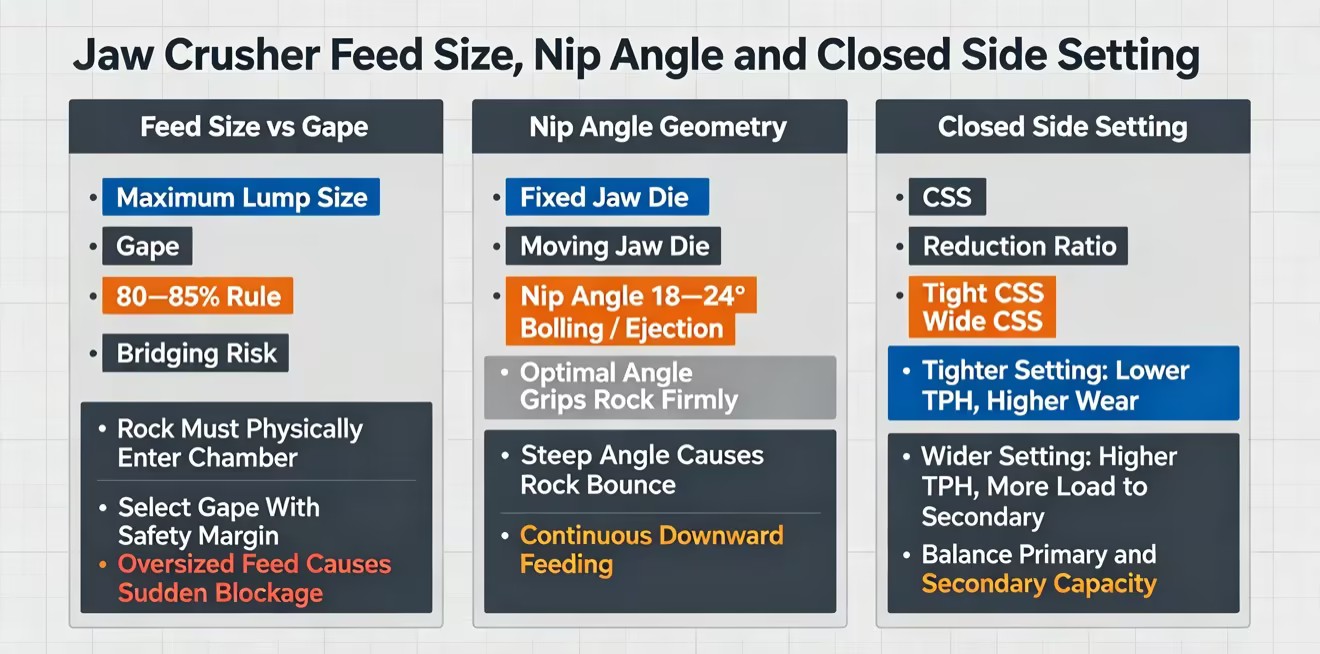
Jaw crusher capacity depends first on whether the feed material can physically enter the crushing chamber. The gape and opening width determine the maximum rock size the machine can handle, while the nip angle controls how effectively the crusher grips and pulls material downward. For primary crushing, the feed size should generally stay within 80–85% of the jaw opening to prevent blockages and unstable operation. Before selecting equipment, measure the largest expected rocks, choose a suitable opening with safety margin, verify the nip angle, and ensure the chamber design supports continuous crushing without stalling.
The Closed Side Setting (CSS) dictates the mechanical reduction ratio. This is the smallest distance between the jaw plates at the bottom of the crushing stroke. Operators typically measure this by dropping a lead weight on a wire into the chamber, cycling the crusher, and measuring the flattened thickness of the lead. The reduction ratio typically sits between 3:1 and 6:1 for a primary Jaw Crusher.
The CSS determines the final product gradation curve exiting the machine. A tighter CSS has a strict inverse relationship with overall capacity. Narrowing the discharge gap inherently reduces volumetric throughput. It forces the machine to perform more work per ton, holding the rock in the chamber longer until it fractures small enough to pass through the gap.
This tighter setting increases wear on the manganese liners. Wider settings increase primary volume significantly. However, this shifts the heavy crushing burden to secondary cone or impact crushers. Primary output size impacts the efficiency of all downstream processing. You must balance primary throughput against secondary capacity limits.
| CSS Setting | Reduction Ratio | Impact on Primary Capacity | Impact on Downstream Equipment |
|---|---|---|---|
| Tight (e.g., 3 inches) | High (6:1) | Lowers TPH, increases manganese wear, raises power draw. | Reduces load on secondary crushers, improves cone efficiency. |
| Medium (e.g., 5 inches) | Standard (4:1) | Balances TPH and wear part longevity. | Provides optimal feed size for standard secondary circuits. |
| Wide (e.g., 8 inches) | Low (3:1) | Maximizes TPH, reduces primary power consumption. | Overwhelms secondary crushers, requires larger cone feed openings. |
Converting volumetric measurements to mass requires specific material bulk density data. You cannot measure true production in cubic yards alone. Mass in tons provides a highly accurate capacity model. Standard bulk density baselines vary wildly across common materials. Heavy ores require different calculations than light sedimentary rocks.
Operators must account for the swell factor of blasted rock. Solid rock expands when fractured, taking up more physical space. A cubic yard of solid granite in the ground weighs more than a cubic yard of blasted granite rubble in a loader bucket. This expansion changes how material flows through the feeder and into the chamber. Accurate tonnage calculations rely on precise density multipliers.
| Material Type | Average Bulk Density (tons/cubic yard) | Impact on Capacity Model |
|---|---|---|
| Solid Granite | 1.35 - 1.45 | High density requires maximum kinetic energy, lowering volumetric throughput. |
| Limestone | 1.20 - 1.30 | Moderate density allows for steady, highly predictable crushing rates. |
| Recycled Concrete | 1.10 - 1.25 | Lower density, but rebar presence often disrupts continuous feeding. |
| Basalt | 1.40 - 1.55 | Extreme density demands robust engine power and reduces hourly tonnage. |
| Sandstone | 1.05 - 1.15 | Highly abrasive but lighter, allowing for faster volumetric processing. |
Rock hardness and moisture conditions have a direct impact on jaw crusher capacity. Harder materials require more crushing force and longer processing time, which reduces hourly output. Parameters such as UCS and the Bond Work Index help evaluate material difficulty before equipment selection. High moisture and clay content can cause material buildup inside the chamber, reducing crushing efficiency and increasing blockage risks. Before operation, test material properties, adjust capacity expectations for wet materials, select suitable jaw dies, and monitor discharge conditions to maintain stable performance.
Engine horsepower correlates directly with sustained capacity under heavy loads. High kinetic energy fractures tough rock efficiently. Massive flywheels store this energy to overcome peak crushing forces. When a massive boulder enters the chamber, the pitman relies on the inertia of the flywheels to drive the crushing stroke home. Undersized motors fail to maintain flywheel RPM during these peak loads, leading to frequent stalling.
This stalling happens even if the physical chamber size is adequate. You must match power requirements relative to your target tonnage. For example, a 130 hp Tier 4 Final diesel engine pairs well with a 160 TPH mobile unit. Larger stationary units processing 800 TPH require massive electric motors exceeding 400 kW. Electric drives offer superior torque characteristics for stationary plants, while diesel-hydraulic systems provide necessary mobility for tracked units.
Calculate the required kilowatt-hours per ton based on material hardness and Bond Work Index.
Ensure the power source handles sudden amperage spikes during heavy crushing events.
Maintain optimal flywheel RPM to preserve kinetic energy momentum.
Inspect drive belts regularly to prevent power transmission losses between the motor and the eccentric shaft.
Choke feeding keeps the crushing chamber full, improving crushing efficiency, output consistency, and jaw plate wear balance. In contrast, uneven feeding leaves the chamber partially empty, reducing capacity and causing uneven wear. Pre-screening equipment such as vibrating grizzly feeders removes fine materials before crushing, reducing energy waste and preventing blockages. To maintain stable performance, match feeder settings with the crusher CSS, control feed speed, and avoid uneven loading that causes material surges.
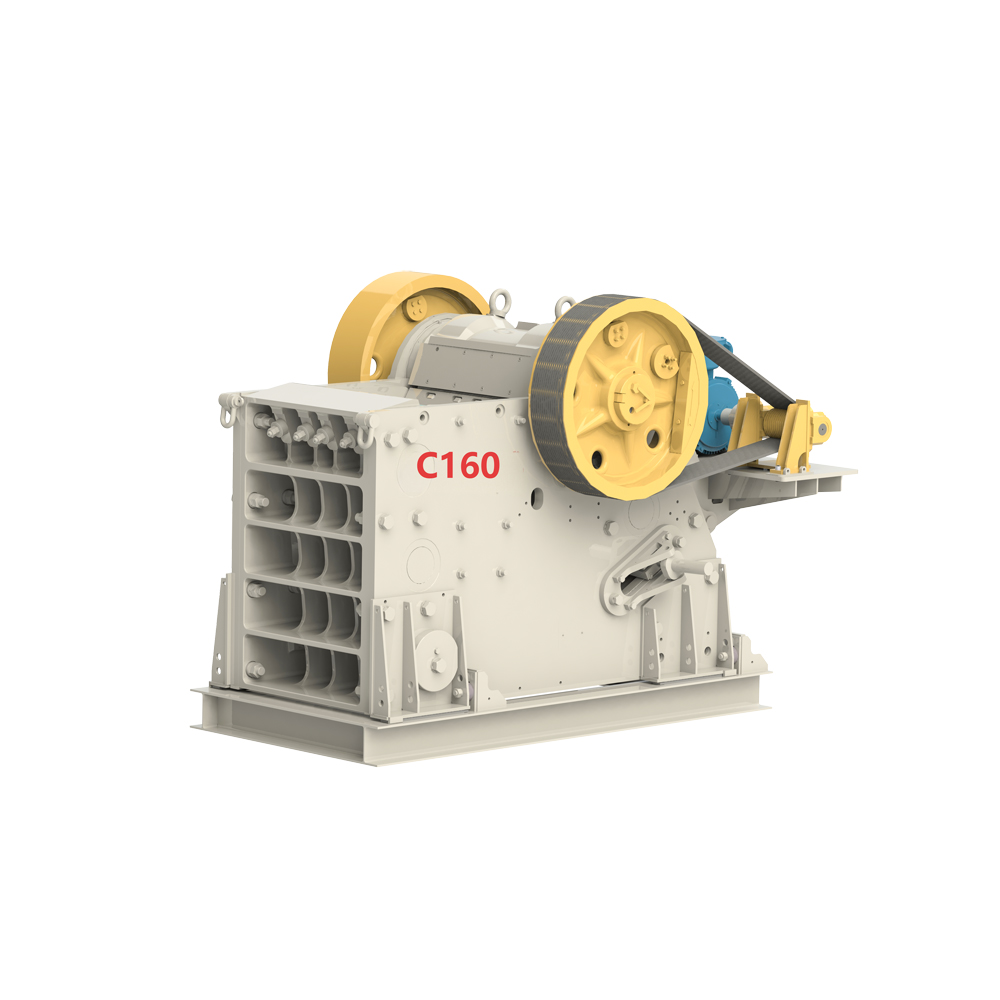
Single-toggle and double-toggle jaw crushers differ mainly in their crushing motion and application focus. Single-toggle models use an elliptical motion that pushes material downward through the chamber, providing higher throughput and better performance for high-volume aggregate production. Double-toggle models use a stronger compression action, making them more suitable for extremely hard and abrasive materials. Although they usually have lower capacity, their reduced wear on components provides better durability and longer service life in demanding applications.
| Feature | Single-Toggle Design | Double-Toggle Design |
|---|---|---|
| Kinematic Motion | Elliptical (compresses and rubs). | Pure compression (straight push). |
| Capacity Potential | High volumetric throughput. | Moderate volumetric throughput. |
| Wear Part Lifespan | Shorter (due to rubbing action). | Longer (due to pure compression). |
| Ideal Application | Limestone, gravel, standard aggregate. | Ferroalloys, hard granite, abrasive ores. |
Portability introduces necessary capacity trade-offs. Tracked mobile units typically range from 100 to 300+ US tph. They offer unmatched flexibility for contractors moving between sites or advancing along a quarry face. Medium-sized modular equipment handles 300–600 tph efficiently, often mounted on skids for semi-permanent installation. High-tonnage stationary plants process 500 to 1,000+ tph continuously.
Site layout constraints dictate your equipment selection. Infrastructure requirements impact continuous feed rates. Mobility offers flexibility but limits maximum sustained tonnage compared to stationary setups. Stationary units utilize massive concrete foundations, allowing for larger chambers, heavier flywheels, and larger dump pockets for haul trucks. Mobile units rely on smaller excavators or wheel loaders, which inherently limits the feed rate.
Deploy tracked units for short-term quarry phases or recycling applications.
Build stationary plants for life-of-mine operations exceeding ten years.
Ensure mobile units have adequate level ground to operate safely without chassis twisting.
Design stationary plant layouts to accommodate heavy haul truck traffic and large surge bins.
Operating a larger unit at 60-70% capacity provides critical operational headroom. Pushing a smaller unit to 95% capacity strains internal components. Energy consumption metrics matter immensely. Kilowatts used per ton of crushed material indicate true mechanical efficiency. Proper motor sizing ensures long-term operational stability and keeps OPEX manageable.
Overworked machines consume more power per ton. They risk sudden mechanical failures. A machine running constantly at its absolute limit generates excessive heat. Bearings degrade faster under sustained peak loads. Sizing up slightly reduces this mechanical stress. It allows the plant to absorb unexpected surges in feed material without tripping breakers or overheating hydraulic systems.
Calculate the energy draw of an idling machine versus a fully loaded machine.
Size the primary unit to handle 120% of your average required daily tonnage.
Monitor pitman bearing temperatures during peak production hours.
Avoid running equipment continuously at maximum rated capacity to extend component life.
Running at maximum capacity with highly abrasive material accelerates wear. Manganese jaw dies degrade faster under constant heavy loads. Scheduled maintenance downtime must factor into annual production models. Wear part replacement cycles interrupt continuous crushing operations. You cannot calculate capacity based on 365 days of uninterrupted uptime.
Calculate true annual yield by subtracting mandatory maintenance hours from theoretical maximum uptime. Flipping jaw dies extends their usable life. The bottom of the die wears faster than the top due to the tighter CSS. Flipping them evens out the wear profile. However, this process requires shutting down the plant for several hours. High-capacity operations must streamline these maintenance procedures to protect overall yield.
Select 18% or 22% manganese steel liners for highly abrasive rock applications.
Schedule jaw die flips during planned plant maintenance windows to minimize production loss.
Keep spare cheek plates and toggle seats in on-site inventory.
Track tonnage processed between liner changes to predict future downtime accurately.
Conduct a comprehensive material gradation analysis on your raw feed stock to determine bulk density and crushability.
Measure your maximum expected lump size to establish the minimum required gape opening before looking at tonnage ratings.
Design adequate surge piles between primary and secondary circuits to prevent bottleneck shutdowns and maintain continuous feed.
Implement rigorous blasting protocols to control feed size at the quarry face and eliminate bridging risks.
A: Capacity varies widely based on machine size, CSS, and material density. Compact tracked mobile units typically process 100 to 300 TPH. Medium-sized equipment handles 300 to 600 TPH. Large stationary mining crushers can exceed 1,000 TPH. Always verify capacity using your specific material characteristics.
A: The baseline calculation involves the Closed Side Setting (CSS), jaw width, gape, material bulk density, engine power, and continuous feed rate. You must convert volumetric flow into mass using the material's specific density multiplier while factoring in the rock's crushability index.
A: A tighter CSS reduces hourly throughput and increases wear on the manganese liners. It forces the machine to perform more reduction work. Conversely, a wider CSS increases primary capacity but requires more robust secondary crushing equipment to handle the larger output material.
A: The industry standard dictates that maximum feed size should be 80-85% of the gape opening. This conservative sizing prevents material bridging, eliminates chamber blockages, and ensures continuous rock-on-rock compression without stalling the machine.
A: Common operational culprits include poor feed distribution, excessive fines bypassing the grizzly, high moisture content causing chamber packing, insufficient motor power, or an improperly calibrated CSS. Trick feeding instead of choke feeding also severely limits hourly tonnage.
A: Harder rocks require more kinetic energy and time to fracture properly. This extended retention time inside the chamber lowers the effective hourly tonnage compared to softer, brittle materials. Extremely hard rock also increases the risk of motor stalling under heavy loads.


