- All
- Product Name
- Product Keyword
- Product Model
- Product Summary
- Product Description
- Multi Field Search


Views: 0 Author: Site Editor Publish Time: 2026-09-18 Origin: Site


A single documentation error during heavy machinery logistics triggers thousands of dollars in daily demurrage fees. It voids letters of credit and stalls site operations. Procuring high-quality crushing equipment requires navigating international trade laws, customs classifications, pre-shipment inspections, and regional safety compliance. These factors dictate your actual landed cost and deployment timeline. You need a precise strategy to move massive industrial assets across borders. This guide provides a technical, decision-stage framework for procurement managers and logistics directors. We show you how to execute a compliant, delay-free Jaw Crusher Export and import process. You will learn to mitigate risk, align financial documentation, and clear customs without costly interventions.
Accurate Classification is Non-Negotiable: Utilizing the correct Harmonized System (HS) code (typically under 8474.20) dictates tariff rates and prevents immediate customs holds.
Regional Compliance Dictates Market Entry: A jaw crusher cannot clear customs without proof of regional safety and environmental compliance (e.g., CE marking for the EU, EPA engine certifications for the US).
Incoterms Define Financial Risk: Selecting the right Incoterm (FOB, CIF, DAP) fundamentally shifts the liability of loading, freight, and insurance between the manufacturer and the buyer.
Financial Documentation Alignment: Discrepancies between the Bill of Lading, Commercial Invoice, and a Letter of Credit (L/C) will freeze bank payments and halt cargo release.
Used vs. New Machinery Nuances: Exporting a used jaw crusher requires stringent phytosanitary and cleaning certificates to prove the absence of soil-borne pathogens, a step often overlooked by first-time importers.
Successful heavy machinery export requires accurate planning, complete documentation, and close coordination between all parties. The equipment must arrive without damage, customs issues, or unexpected costs. Missing certificates, incorrect documents, or poor coordination can cause delays, storage fees, and insurance problems. To avoid these risks, OEMs, freight forwarders, customs brokers, inspectors, and site teams must confirm requirements and timelines before shipment.
| Stakeholder | Primary Export Responsibility | Failure Consequence |
|---|---|---|
| Original Equipment Manufacturer (OEM) | Provide accurate technical specs, compliance certificates, and proper export packaging. | Cargo rejected at origin port; severe corrosion during transit. |
| Freight Forwarder | Secure vessel space, arrange heavy-haul permits, and manage terminal handling. | Missed sailings; heavy standby fees for inland transport. |
| Customs Broker | Classify HS codes, submit import declarations, and manage duty payments. | Cargo seized by customs; massive demurrage penalties. |
| Third-Party Inspector | Verify physical condition and documentation against the commercial invoice. | Import blocked by destination country regulations. |
Heavy machinery requires detailed documentation. The commercial invoice and packing list should include machine models, serial numbers, dimensions, weights, and lifting information. Accurate details help customs officers and port operators handle the equipment safely and avoid delays.
The Bill of Lading is the legal shipping document for cargo ownership and transportation. Buyers can choose between an Original B/L for higher security or a Telex Release for faster cargo release after establishing supplier trust.
For L/C payments, all documents must match the contract details exactly. Differences in machine specifications, weight, or shipping information may delay bank approval and cargo release.
The Certificate of Origin confirms where the jaw crusher was manufactured. It may help buyers qualify for reduced import duties under trade agreements. Ensure all company details match the commercial invoice.
Correct HS code classification is essential for customs clearance. Jaw crushers are commonly classified under HS code 8474.20, but local customs requirements may add additional digits. Always confirm the final code with a customs broker before shipment.
Some countries require Pre-Shipment Inspection (PSI) before heavy machinery export. Third-party inspectors verify machine condition, serial numbers, value, and export documents before issuing inspection certificates.
A missing PSI certificate may prevent customs clearance and cause storage fees at the destination port. Completing inspection before shipment helps avoid unnecessary delays.
Some heavy equipment exports require an End-User Certificate to confirm the machine will be used for approved industrial purposes. Buyers may need to provide company information and intended application details.
Export approval should be completed before shipping. Delays in obtaining required certificates can affect vessel booking and project schedules.
Different markets require different compliance standards:
EU: CE marking and Machinery Directive compliance
USA: EPA engine requirements for diesel-powered equipment
CIS markets: EAC certification requirements
Confirm required certifications during procurement, not after shipment.
Wood packaging for international shipments should comply with ISPM 15 standards. Heat-treated and certified wood prevents customs quarantine issues.
Ocean transportation exposes equipment to moisture and salt air. Protect critical components with rust preventatives and VCI film to prevent corrosion during transit.
Used jaw crushers may require cleaning certificates before export. Remove all soil, dust, and organic materials to meet destination-country requirements and avoid customs delays.
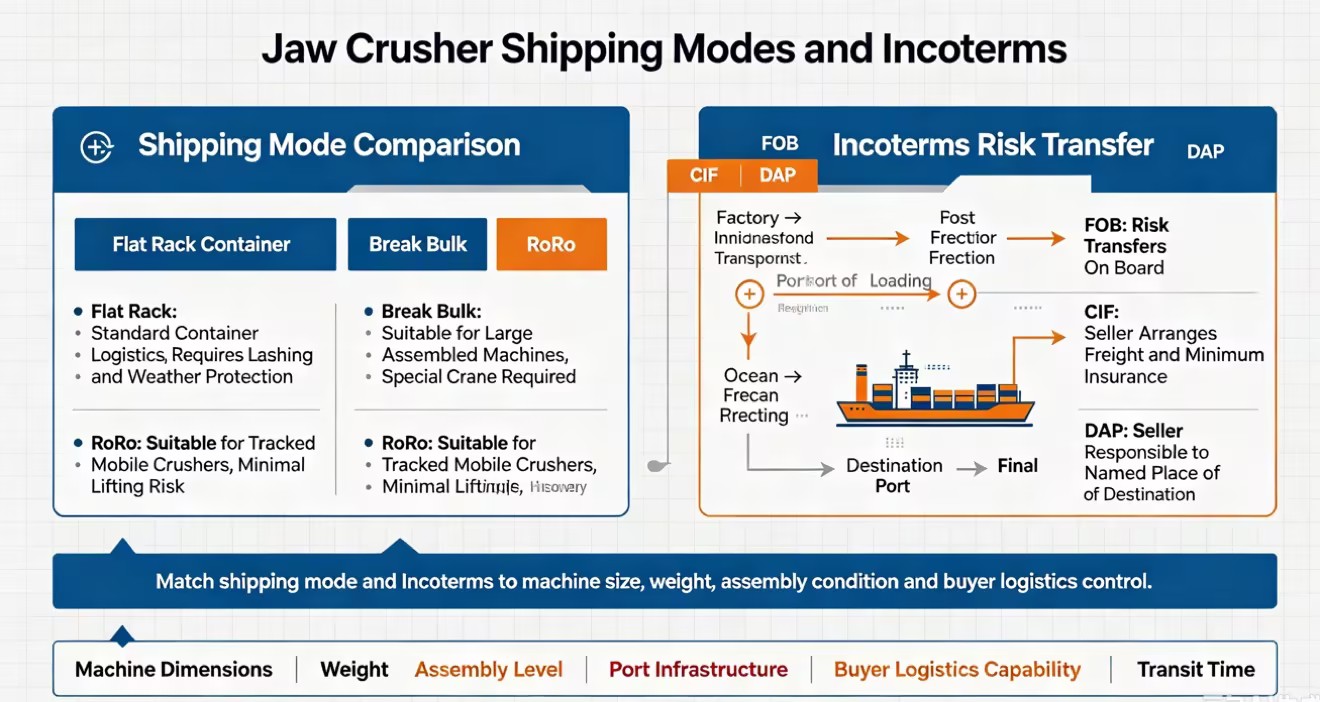
Selecting the right shipping modality balances freight costs against physical security and reassembly labor. Standard closed containers rarely fit heavy mining equipment. You must evaluate specialized Out of Gauge (OOG) options based on the machine's dimensions and the project's budget. Each modality requires different lifting plans and port handling procedures.
| Shipping Modality | Best Used For | Primary Advantages | Key Disadvantages |
|---|---|---|---|
| Flat Rack Container | Stationary crushers, dismantled main frames. | Integrates into standard container ship logistics; frequent sailings. | Requires complex lashing and tarping; exposed to weather. |
| Break Bulk | Massive, fully assembled stationary plants. | Handles extreme weights and oversized dimensions safely. | Limited vessel availability; requires specialized port cranes. |
| Roll-on/Roll-off (RoRo) | Track-mounted mobile crushers. | Machine drives directly onto the ship; minimal lifting risk. | Fewer destination ports support heavy RoRo ramps. |
You must also decide whether to ship the machine fully assembled or dismantled. Shipping a fully assembled machine requires Break Bulk or RoRo vessels, which carry high freight premiums. Dismantling the main frame, removing the flywheels, and detaching the feed hopper reduces the overall volume. This allows the components to fit onto standard Flat Racks or Open Top containers, lowering the ocean freight cost. However, you must calculate the cost of hiring local cranes and mechanics to reassemble the machine at the destination site. Sometimes, the labor cost of reassembly exceeds the freight savings. You must run a comparative analysis before finalizing the shipping method.
Moving a large jaw crusher to the port requires specialized logistics. Heavy-haul permits, multi-axle trailers, and proper load distribution are necessary to ensure safe transportation. Standard trucks are not suitable for oversized machinery.
Transport routes must be checked in advance for bridge height limits, road restrictions, and weight requirements. For oversized cargo, escort vehicles may be required. The delivery schedule must also match the port receiving window to avoid additional waiting charges.
Ports require detailed lifting plans, including the machine’s center of gravity and lifting points. Proper documentation ensures safe unloading and prevents delays during cargo handling.
Incoterms define cost responsibilities and risk transfer between buyers and sellers. Selecting the correct term helps avoid unexpected logistics costs and insurance issues.
FOB is suitable for buyers with their own logistics network. The seller handles delivery to the port and loading, while the buyer manages ocean freight and insurance after shipment loading.
CIF allows the seller to arrange ocean freight and basic insurance to the destination port. It is convenient for buyers with limited shipping experience, but buyers should confirm shipping costs, insurance coverage, and potential destination charges before choosing this term.
Executing a successful export operation relies entirely on proactive documentation, strict adherence to destination-country compliance, and robust financial alignment. Finding the cheapest ocean freight rate is irrelevant if the machine sits in customs for a month accruing demurrage fees. You must treat the paperwork with the same level of engineering precision as the machinery itself. A single missing stamp on a certificate of origin or a mismatched serial number on a commercial invoice will derail your entire procurement timeline.
When shortlisting logistics partners, prioritize specialization over general freight rates. Select freight forwarders and customs brokers who specialize specifically in heavy mining and construction equipment. They must have proven experience handling Out of Gauge cargo, securing heavy haul permits, and navigating complex industrial customs classifications. Do not trust your multi-million dollar asset to a forwarder who only ships palletized consumer goods.
To ensure a compliant export process, execute the following steps immediately:
Audit your manufacturer's compliance portfolio to verify they hold valid CE, EPA, or EAC certifications for your specific destination market.
Contact your local customs broker to confirm the exact HS code and verify if your country mandates a Pre-Shipment Inspection for industrial machinery.
Draft your Letter of Credit instructions in direct coordination with your freight forwarder to ensure the banking terms match the logistical realities of OOG shipping.
Mandate the use of VCI packaging and ISPM 15 certified wood in your initial purchase order to prevent corrosion and quarantine risks.
A: The standard international Harmonized System (HS) code is 8474.20. This category covers crushing or grinding machines for earth, stone, or ores. However, destination countries often require additional digits to classify whether the equipment is stationary, mobile, or diesel-powered. Always verify the full local code with your customs broker.
A: A PSI is a mandatory verification process required by certain importing countries. Independent agencies like SGS or Bureau Veritas inspect the machinery at the factory before export. They verify the equipment's physical condition, confirm its financial value, and check the documentation to prevent fraud and ensure safety compliance.
A: Yes, exporting used machinery requires strict phytosanitary compliance. You must thoroughly wash the equipment to remove all foreign soil, rock dust, and organic matter. A certified inspector must issue a cleaning certificate to prove the machine will not introduce agricultural pests or soil-borne pathogens into the destination country.
A: Protect the equipment by coating all exposed machined surfaces with cosmoline or heavy rust preventatives. Wrap the entire machine in Volatile Corrosion Inhibitor (VCI) film. VCI releases molecules that form a protective layer on the metal, neutralizing the corrosive effects of saltwater and high humidity during transit.
A: Fully assembled crushers rarely fit in standard closed containers due to extreme weight and dimensions. You must typically use specialized Out of Gauge (OOG) solutions like Flat Racks, Open Top containers, Break Bulk vessels, or Roll-on/Roll-off (RoRo) shipping, depending on whether the machine is dismantled or track-mounted.
A: The CE marking indicates that the machinery complies with the European Union's strict health, safety, and environmental protection standards. For crushing equipment, this primarily involves meeting the requirements of the Machinery Directive for operational safety and specific regulations regarding outdoor noise emissions.
A: Under EXW terms, the buyer assumes all risks and responsibilities. The buyer must arrange the loading at the factory, secure the inland transport, and process all export customs clearance documentation. This is highly risky for heavy machinery, as the buyer lacks local leverage to resolve origin customs issues.


