- All
- Product Name
- Product Keyword
- Product Model
- Product Summary
- Product Description
- Multi Field Search


Views: 0 Author: Site Editor Publish Time: 2026-09-18 Origin: Site


Small-scale mining operations face distinct economic pressures. You need to process ore efficiently without the massive upfront capital required for permanent infrastructure. Traditional stationary crushing plants demand extensive site preparation, concrete foundations, and high haulage costs as the mine face advances. This creates a logistical bottleneck and inflates the cost per ton.
Integrating a Mobile Jaw Crusher shifts the operational model from a fixed-asset dependency to an agile processing strategy. Operators can crush right at the rock face. This drastically reduces material double-handling. You eliminate the need for a dedicated haul truck fleet running endless loops from the pit to a fixed plant. Instead, you bring the primary crushing stage directly to the extraction point. This streamlines material flow and adapts instantly to changing site geology.
Haulage Cost Reduction: Crushing at the extraction point eliminates the need for a dedicated haulage fleet to transport raw ore to a central processing plant.
Deployment Agility: Tracked and wheeled configurations allow for rapid commissioning, bypassing the lengthy permitting and construction phases of stationary plants.
Asset Flexibility: Mobile units maintain high resale value and can be easily relocated to new claims or contracted out, reducing long-term financial risk.
Small-scale mining operations often struggle with the high cost and limited flexibility of fixed crushing plants. Stationary plants require large foundations, site preparation, and permanent power connections, which can delay production and increase initial investment.
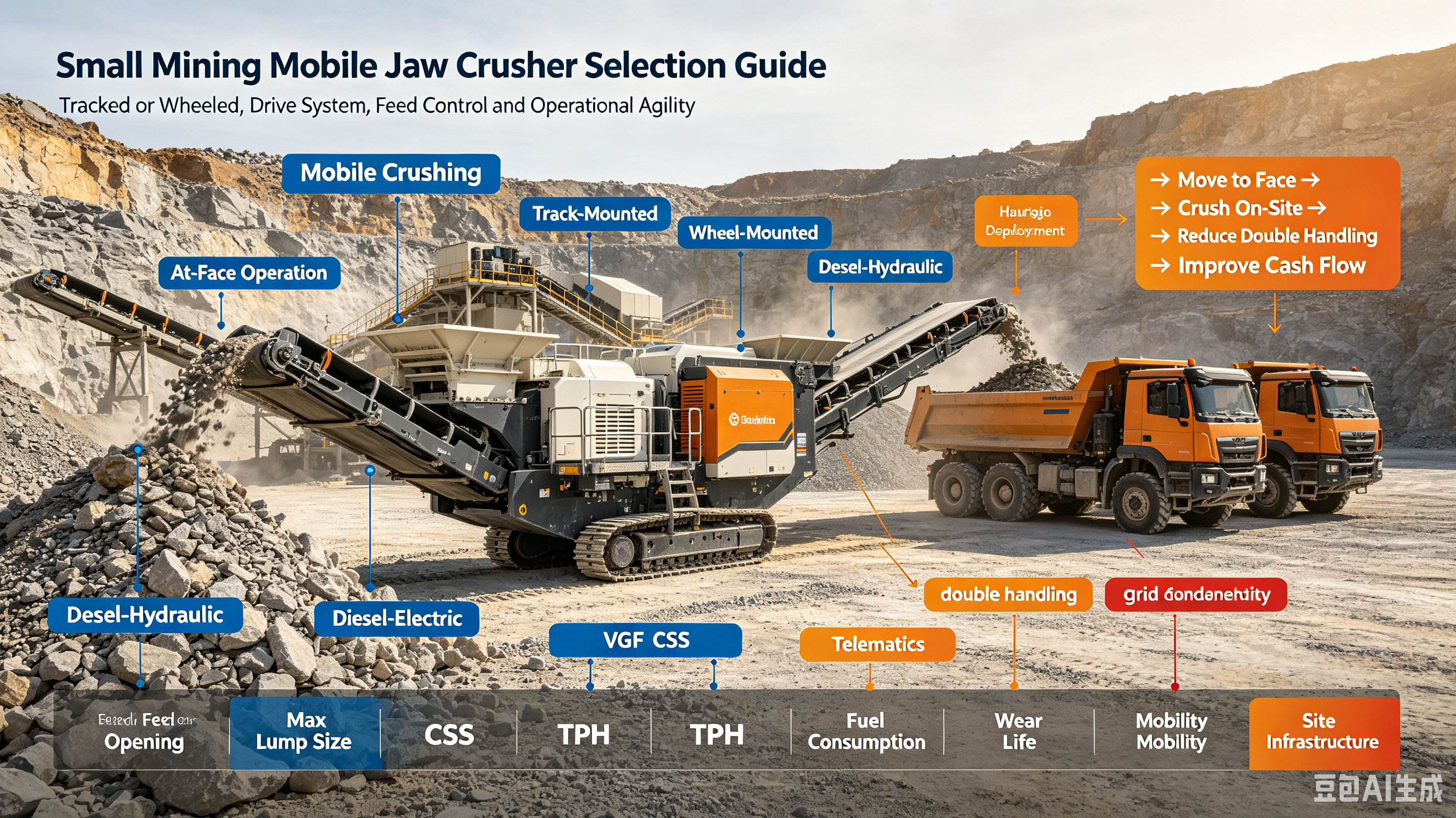
Fixed plants create several operational challenges:
High Installation Costs: Concrete foundations, site preparation, and electrical infrastructure require significant time and investment.
Long Material Transport Distance: As the mine expands, the distance between the mining face and crusher increases, raising haulage costs.
Double Material Handling: Raw ore must be transported, stockpiled, and loaded again before crushing.
Power Infrastructure Dependency: Remote sites often need expensive power lines or large generator systems.
Mobile jaw crushers move the primary crushing stage closer to the extraction point. This reduces material transportation, lowers fuel consumption, and minimizes the need for large haul truck fleets.
A suitable mobile crushing solution should provide:
Independent Power Supply: Operates without relying on permanent grid connections.
Required Production Capacity: Handles the site's target TPH and rock conditions.
Large Feed Capability: Processes the same feed size requirements as traditional crushing systems.
By replacing long-distance hauling with direct crushing and conveying, small mines can improve flexibility, reduce operating costs, and respond quickly to changing site conditions.
Translating the massive crushing power of a traditional Jaw Crusher into a self-propelled platform requires precise engineering. The core challenge is maintaining structural rigidity and crushing force while shedding the weight of a concrete foundation. Manufacturers achieve this by mounting the crushing chamber, feeder, and power unit onto heavy-duty chassis systems designed for mobility.
The choice between crawler tracks and wheeled chassis dictates the machine's operational footprint. Track-mounted units utilize heavy-duty crawler systems that distribute the machine's immense weight over a large surface area. This low ground pressure allows the equipment to navigate blasted rock, deep mud, and steep pit gradients. Tracked units excel in environments where the machine must move frequently. They often shift daily to stay within reach of the feeding excavator as the mine face advances. They maneuver via remote control, requiring no external towing equipment.
Conversely, wheel-mounted portable plants are built on multi-axle chassis equipped with fifth-wheel towing hitches. These units are designed for highway transport using standard heavy-haul semi-trucks. While they lack the off-road autonomy of tracked units, they deploy rapidly across multiple distant sites. Wheel-mounted configurations suit mining contractors who operate several small quarries and need to relocate their primary crushing asset weekly or monthly without the expense of lowboy trailers.
| Feature | Track-Mounted (Crawlers) | Wheel-Mounted (Portable) |
|---|---|---|
| Mobility Type | Self-propelled via remote control | Towed via heavy-haul truck |
| Terrain Capability | Excellent on blasted rock, mud, and inclines | Requires graded, compacted flat pads |
| Relocation Frequency | Daily movements along the mine face | Weekly/Monthly relocations between sites |
| Setup Time | Minutes (Drive into position and crush) | Hours (Requires leveling jacks and blocking) |
The power delivery mechanism dictates the machine's reliability and efficiency. Traditional diesel-hydraulic systems use an onboard diesel engine to drive a series of hydraulic pumps. These pumps push pressurized fluid to hydraulic motors that turn the crusher flywheels, operate the tracks, and run the conveyors. This system is mechanically robust and offers excellent torque for clearing stalled chambers. However, it requires rigorous fluid maintenance, is susceptible to hydraulic leaks, and suffers from energy loss through fluid heat.
Modern diesel-electric hybrid drives represent a massive leap in efficiency. In this configuration, the diesel engine turns an alternator to generate electricity. This power drives electric motors connected to the crusher and conveyors via variable frequency drives (VFDs). Diesel-electric systems offer superior fuel efficiency, lower emissions, and precise control over component speeds. Furthermore, if the mine site eventually secures grid power, diesel-electric units can often plug directly into the mains. This entirely bypasses the diesel engine and drastically cuts operating expenses.
Agile crushing relies heavily on intelligent control systems. Advanced automation prevents the most common cause of downtime: operator error. Onboard sensors continuously monitor the load inside the crushing chamber and the speed of the engine. If the chamber begins to overfill, the automated control system instantly reduces the speed of the vibrating grizzly feeder, preventing a blockage. Once the chamber clears, the feeder ramps back up to optimal speed.
Telematics integration extends this control beyond the machine. Remote fleet monitoring allows mine managers to track fuel consumption, idle time, and tons processed per hour from a smartphone or desktop. These systems log fault codes and monitor fluid temperatures, enabling predictive maintenance schedules. Instead of waiting for a component to fail catastrophically, maintenance teams receive alerts when a bearing temperature spikes, allowing them to intervene during scheduled downtime.
Selecting the right mobile unit requires aligning the machine's mechanical capabilities with the specific geological characteristics of the mine. A mismatch between the rock profile and the crusher's specifications will result in severe production bottlenecks, excessive wear, and frequent mechanical failures.
The physical dimensions of the feed opening dictate the maximum rock size the machine can ingest. This rectangular opening is measured by its width and the gape (the distance between the fixed and moving jaw at the top). Matching the feed opening to the site's blasting profile is non-negotiable. If the blast yields boulders that exceed the gape, the rocks will bridge across the opening. Bridging halts production entirely, requiring an excavator with a hydraulic breaker to clear the blockage. Operators must analyze their typical blast fragmentation and select a feed opening that accommodates the 80th percentile of their top size, ensuring smooth, uninterrupted material flow.
You also need to evaluate the nip angle. The nip angle is the angle between the fixed and moving jaw. It must be optimized to grip the rock rather than forcing it upward. If the nip angle is too wide, round river rock or smooth boulders will simply bounce on top of the chamber, causing severe wear and zero production. Operators dealing with glacial till or river gravel must specify jaw dies with aggressive tooth profiles to improve the gripping action and force the material down into the crushing zone.
The Closed-Side Setting (CSS) is the gap between the jaw dies at the very bottom of the crushing chamber during the maximum forward stroke of the pitman. The CSS determines the maximum size of the crushed product exiting the machine. Adjusting the CSS on a modern mobile unit is typically achieved via hydraulic wedges. This allows operators to change the setting in minutes via push-button controls, rather than manually swapping heavy steel shims.
Controlling the CSS is vital for managing output gradation. The primary crusher prepares the rock for the secondary stage. If the CSS is set too wide, oversized material will overwhelm the secondary cone or impact crusher. If set too tight, the primary crusher's throughput will plummet, and the jaw dies will wear prematurely. Operators must continuously monitor the gradation curve of the output and adjust the CSS to maintain the optimal feed size for downstream equipment.
The efficiency of the primary crushing stage relies heavily on the vibrating grizzly feeder (VGF). The VGF sits beneath the loading hopper and performs two critical functions. It meters the flow of rock into the jaw, and it scalps out undersized material before it enters the chamber. Sending dirt, clay, or rock that is already smaller than the CSS into the jaw chamber wastes massive amounts of energy. It causes packing, increases wear on the manganese dies, and reduces the machine's overall throughput. By adjusting the gap between the grizzly bars, operators can bypass these fines directly to the main discharge conveyor or route them to a separate side dirt belt. Managing this bypass effectively can increase the primary crusher's capacity by up to 20 percent.
Procurement teams must differentiate between manufacturer nameplate capacity and realistic operational yield. Nameplate capacity is often calculated using medium-hard limestone under perfect feeding conditions. Actual yield fluctuates wildly based on the material's Bond Work Index. Crushing dense basalt or granite requires more kinetic energy and yields significantly lower tons per hour than crushing soft sandstone.
Moisture content and material stickiness also impact yield. High clay content can blind the vibrating grizzly scalper, forcing fine, muddy material into the jaw chamber where it packs between the corrugations, reducing crushing efficiency. Furthermore, the actual yield is entirely dependent on the excavator operator's ability to maintain a steady, consistent feed rate. A machine rated for 300 TPH will only produce 150 TPH if the excavator cycle times are too slow.
A primary crusher rarely operates in isolation. It is usually the first machine in a closed-circuit crushing train. Procurement must assess how seamlessly the primary unit integrates with secondary crushers and mobile screens. The discharge conveyor of the primary unit must reach the feed hopper of the secondary unit without requiring intermediate transfer conveyors. Additionally, the electrical and control systems should interlock. If the secondary cone crusher experiences a fault and stops, the interlocking system must immediately halt the primary crusher's discharge belt and feeder to prevent burying the stalled machine in rock.
When evaluating downstream compatibility, verify these specific integration points:
Discharge Height: Ensure the primary conveyor has enough clearance to feed directly into the secondary hopper without a transfer belt.
Interlocking Controls: The entire crushing train must communicate. If the screen plant trips, the primary feeder must automatically pause.
Power Sharing: Some diesel-electric primary crushers generate enough excess power to run a secondary screen plant, saving fuel.
Transport Dimensions: The entire circuit must meet local transport regulations for width and weight.
Transitioning to mobile processing requires a shift in financial modeling. While fixed plants spread their costs over decades of static operation, mobile units deliver immediate returns through logistical efficiency and rapid deployment.
The initial capital expenditure for a tracked crushing plant is substantial. The integration of tracks, diesel engines, and hydraulic systems commands a premium over a bare stationary crusher. However, you must weigh this upfront investment against the deferred costs of civil works. A stationary plant requires months of site preparation, engineering fees, and concrete work before a single ton of rock is crushed. A mobile unit arrives on a lowboy trailer, tracks off, and begins generating revenue the same day. This operational agility allows mining companies to start cash-flowing immediately, accelerating the break-even point despite the higher initial equipment cost.
Understanding the ongoing operating expenses is critical for maintaining profitability. Diesel fuel consumption is the most visible daily expense, making the choice between diesel-hydraulic and diesel-electric drives highly impactful. Wear parts constitute the second major OPEX category. The corrugated manganese steel jaw dies, cheek plates, and toggle seats degrade based on the abrasiveness of the ore.
Jaw die selection plays a massive role in OPEX. Standard corrugated dies work well for general limestone and gravel. However, if you are crushing highly abrasive granite, you need heavy-duty, thick-profile dies with a higher manganese content. While these premium dies cost more upfront, they significantly extend the wear life and reduce the frequency of maintenance shutdowns. You also need to factor in the cost of cheek plates, which protect the sides of the crushing chamber, and the toggle plate, which acts as the mechanical fuse for the entire system.
The true financial power of mobile crushing lies in the elimination of double-handling. In a traditional setup, an excavator loads a dump truck, the truck drives to the plant, dumps the rock, and drives back. By positioning the crusher directly at the rock face, the excavator loads the raw ore straight into the crusher's hopper. The crushed material is then discharged directly into road-legal transport trucks or onto overland conveyors. This direct-loading methodology completely eliminates the off-road haulage fleet. The savings in haul truck fuel, tire replacement, operator wages, and haul road maintenance often offset the operating costs of the mobile crusher entirely, delivering a massive return on investment.
| Expense Category | Stationary Plant | Mobile Crushing Unit |
|---|---|---|
| Fuel/Power | Grid electricity (lower cost per kW) | Diesel fuel (higher cost per operating hour) |
| Haulage Fleet | Requires multiple rigid dump trucks | Eliminated (direct loading at the face) |
| Wear Parts | Standard jaw dies and liners | Standard jaw dies and liners |
| Site Maintenance | High (haul road grading, dust control) | Low (crusher moves to the rock) |
Deploying heavy machinery in dynamic, often isolated environments introduces specific operational risks. Proactive management and strict adherence to safety protocols are required to prevent catastrophic downtime and ensure site safety.
Remote mining sites suffer from extended supply chain lead times. A failed bearing or a snapped conveyor belt can halt production for weeks if replacement parts must be shipped from a distant warehouse. The risk of prolonged downtime due to parts availability is a primary concern.
You must aggressively manage your inventory to mitigate this risk. Mine operators must maintain an on-site inventory of critical wear parts and common failure items, including toggle plates, tension rods, hydraulic filters, and conveyor splicing kits. Furthermore, procurement contracts should mandate strict service-level agreements with equipment vendors, guaranteeing technician dispatch times and prioritized parts delivery for critical breakdowns.
Operating a mobile crushing plant is vastly more complex than driving a haul truck. The operator must understand material flow, hydraulic pressures, and the mechanical limits of the crushing chamber. Inexperienced operators frequently cause severe damage by feeding uncrushable tramp iron into the machine, or by burying the chamber in oversized boulders.
Mitigation relies entirely on comprehensive training. Equipment manufacturers or certified dealers must provide rigorous OEM training for all operators. This training must cover proper feeding techniques, recognizing the sound of a stalling flywheel, and executing emergency shutdown procedures. You must verify competency before allowing an operator to manage the feed rate.
The physical dangers of operating crushing equipment are severe. Bridging occurs when oversized rocks wedge in the feed opening. Uncrushable materials can stall the pitman, leaving the machine jammed with massive amounts of stored kinetic energy in the flywheels. Historically, clearing these blockages required personnel to climb into the chamber with pry bars or explosives, resulting in frequent fatalities.
Mitigation involves leveraging modern safety technology. Operators must prioritize models equipped with hydraulic toggle relief systems. When an uncrushable object enters the chamber, the hydraulic system automatically opens the jaw to let the object pass, then resets to the original CSS. Additionally, radio remote controls keep operators safely inside the armored cab of the feeding excavator, removing them entirely from the hazard zone during operation.
Mining operations face strict scrutiny regarding airborne particulates and noise pollution. Crushing dry rock generates massive plumes of silica dust, which poses severe respiratory hazards and violates environmental regulations. The diesel engines and crushing action also generate significant decibel levels.
Mitigation requires utilizing the machine's built-in environmental controls. High-pressure water spray bars must be active at the crusher intake, the discharge chute, and all conveyor transfer points to suppress dust before it becomes airborne. Engine canopies must be fitted with acoustic dampening materials to reduce noise propagation, ensuring the site remains compliant with local mining and environmental authorities.
To successfully transition to a mobile crushing operation, execute the following next steps:
Conduct a comprehensive site audit to map the advancing mine face and determine the optimal daily relocation path for tracked equipment.
Request a detailed material flow analysis from equipment vendors, utilizing actual blast fragmentation data to size the feed opening correctly.
Demand on-site equipment demonstrations using the mine's actual ore to verify throughput and fuel consumption claims under real-world conditions.
Establish a dedicated on-site inventory for high-wear items like manganese dies and toggle plates before commissioning the machine.
A: With rigorous preventative maintenance, the chassis and main frame can last 15 to 20 years. Wear components like manganese jaw dies, cheek plates, and conveyor belts require regular replacement. The diesel engine and hydraulic pumps typically require major overhauls or replacement between 10,000 and 15,000 operating hours, depending on the severity of the environment.
A: Mobile units typically have higher direct operating costs per hour due to diesel fuel consumption and specialized maintenance. However, the cost per ton is often lower because mobile units eliminate the massive expenses associated with operating and maintaining a dedicated haul truck fleet.
A: Yes, they are specifically designed for hard rock applications. Crushing highly abrasive materials accelerates the wear on the manganese steel jaw dies. Operators processing quartzite or basalt must monitor wear patterns daily and maintain a robust inventory of replacement dies to prevent damage to the underlying pitman.
A: Track-mounted units cannot be towed on highways. They must be driven onto heavy-duty lowboy trailers using their remote-controlled tracks. Depending on the machine's total weight and dimensions, transport may require specialized multi-axle trailers, oversize load permits, and pilot vehicles to comply with regional highway regulations.
A: Replacement frequency depends entirely on rock abrasiveness and throughput, ranging from a few weeks in highly abrasive rock to several months in soft limestone. Maintenance teams routinely perform replacements in the field. They use onboard lifting cranes or site excavators to remove the worn dies.
A: Modern units feature hydraulic toggle relief systems. If an uncrushable object like an excavator tooth enters the chamber, hydraulic cylinders instantly retract, widening the gap to let the object pass without snapping the toggle plate. Once cleared, the system automatically resets the jaw to the original setting.
A: Telematics provide real-time data on fuel consumption, engine load, and idle times. Mine managers can identify inefficiencies, such as the machine idling while waiting for the excavator. Telematics also transmit fault codes and fluid temperatures, allowing maintenance teams to schedule repairs before catastrophic failures occur.


