- All
- Product Name
- Product Keyword
- Product Model
- Product Summary
- Product Description
- Multi Field Search


Views: 0 Author: Site Editor Publish Time: 2026-09-18 Origin: Site


Selecting a primary crushing plant dictates downstream operational efficiency, maintenance overhead, and profit margins. Site managers face a constant tension. You want to maximize throughput capacity while minimizing material handling costs over the lifespan of a quarry, mine, or construction site. Every ton of rock moved by a haul truck before reaching the primary crusher eats directly into site profitability.
A rigorous technical evaluation determines whether a stationary plant or a mobile unit aligns with specific geological, logistical, and financial realities. This evaluation sets the stage for a definitive Fixed Jaw Crusher vs Mobile comparison. We will explore how site lifespan, haulage logistics, and power availability drive this equipment selection. You need the right architecture for your material reduction needs.
Site Lifespan Dictates Architecture: Fixed plants offer superior ROI for multi-decade quarry operations, while mobile units are essential for transient sites, contract crushing, or phased mining.
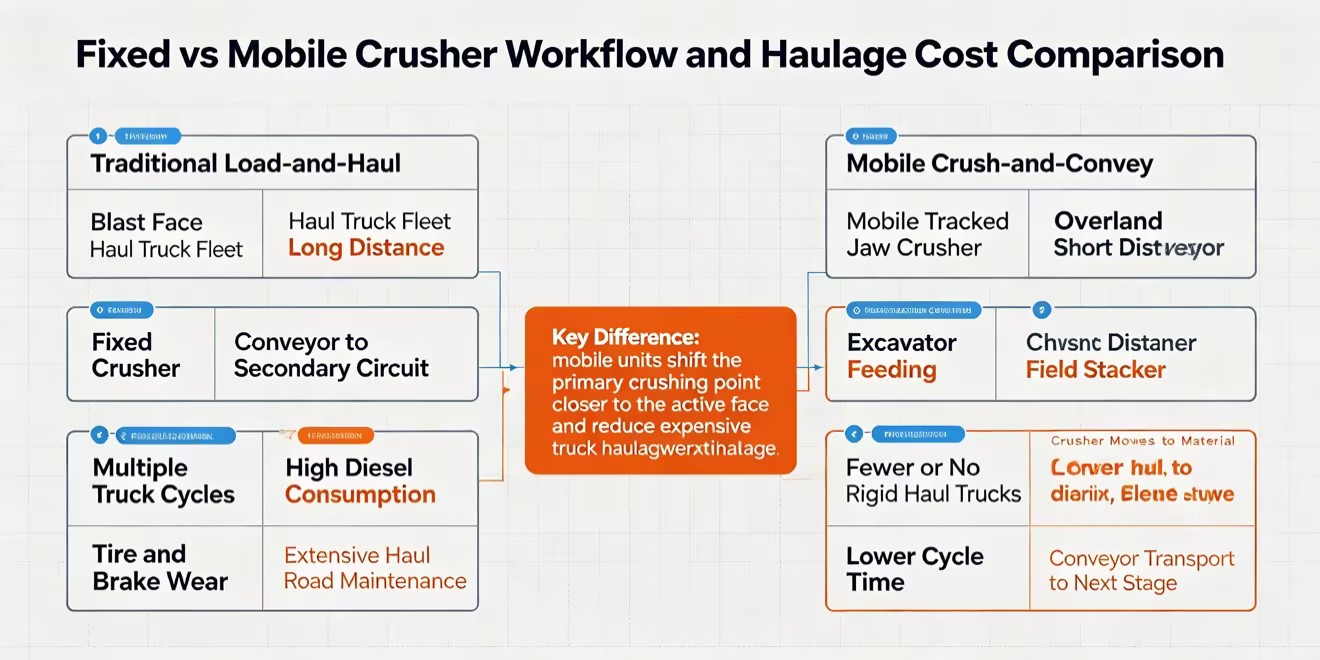
Haulage Cost Reduction: Mobile jaw crushers directly reduce total haul truck distances by moving with the quarry face, shifting transport from trucks to more efficient overland conveyor systems.
Throughput vs. Flexibility: Fixed jaw crushers generally accommodate larger feed sizes and higher tons-per-hour (TPH) capacities, whereas mobile units trade absolute peak capacity for rapid deployment and versatility.
Power and Infrastructure: The decision heavily relies on access to grid power (favoring fixed) versus reliance on diesel-hydraulic or diesel-electric drives (standard for mobile).
Asset Liquidity: Mobile units offer higher resale value and flexibility on the secondary market, whereas fixed plants represent a long-term sunk cost in civil infrastructure.
Jaw crushers are commonly used as primary crushers to reduce large rocks and recycled materials through compression. Before selecting equipment, define key project requirements such as production capacity, maximum feed size, material hardness, and site operating period. These factors help avoid choosing undersized equipment or unnecessary high-capacity machines. The operator’s working conditions also matter: contractors often need flexible equipment for multiple sites, while permanent quarries focus more on long-term reliability and lower operating costs. In addition, reducing the distance between the material source and crusher can significantly lower hauling costs, fuel consumption, and overall operating expenses.
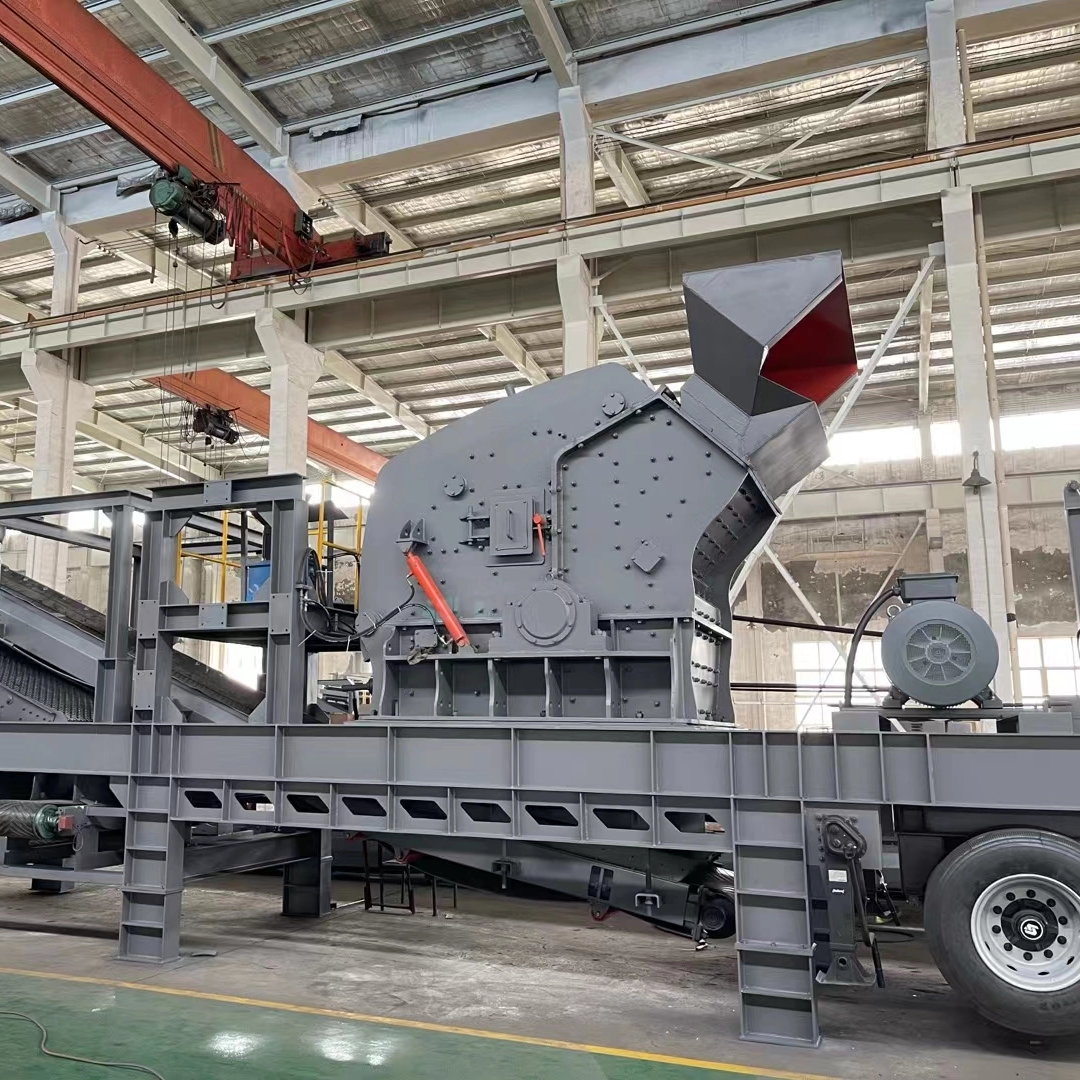
Fixed crushing plants require significant site preparation before operation. They need strong concrete foundations, stable ground conditions, and permanent infrastructure to handle heavy loads and continuous vibration. Installation usually takes several months because it involves engineering surveys, construction work, equipment assembly, and system alignment. This makes fixed plants more suitable for long-term quarry operations where the location and production plan are stable.
Fixed systems hold a distinct advantage when handling massive feed sizes. Without the weight and dimensional constraints of a mobile chassis, manufacturers engineer stationary jaw crushers with enormous feed openings. These massive machines sustain continuous, high-volume throughput day after day. They easily process oversized boulders that would otherwise require secondary rock breaking or secondary blasting, streamlining the extraction process.
Stationary primary crushers integrate seamlessly with large-scale, permanent secondary and tertiary crushing circuits. A fixed jaw crusher feeds directly into heavy-duty surge bins and permanent overland conveyors. This allows for highly optimized, multi-stage material reduction. Operators fine-tune the closed-circuit system with massive vibrating screens and cone crushers, achieving a highly consistent end-product gradation that mobile units struggle to match at the same volume.
Fixed plants have advantages in operating cost and maintenance efficiency due to their stable infrastructure. They typically use three-phase grid power, which reduces energy costs and avoids fuel supply challenges compared with diesel-powered systems. Their permanent design also provides better maintenance access, with dedicated walkways, platforms, and lifting equipment that make inspections and component replacement safer and faster, helping reduce downtime.
Tracked and wheeled Mobile Jaw Crushers completely redefine site logistics. Manufacturers engineer these units on heavy-duty crawler tracks or multi-axle wheeled chassis, allowing them to navigate rugged terrain independently. Operators transport these machines via standard lowboy trailers. By folding hydraulic hopper extensions and lowering discharge conveyors, these crushers meet strict highway transport dimensions, avoiding the need for complex oversized load permits in many jurisdictions.
Setup times drop from months to mere hours. Once the lowboy unloads the machine, an operator tracks the crusher into position, unfolds the conveyors hydraulically, and begins crushing the same day. This rapid deployment makes mobile units ideal for road construction, demolition recycling, pipeline projects, and multi-site contract crushing. When the material source frequently moves, the ability to pack up and relocate the primary crusher within a single shift provides an unbeatable competitive advantage.
Mobile crushers reduce transportation costs by moving the crushing process closer to the material source. Instead of transporting raw material over long distances to a fixed plant, operators can place the mobile crusher near the quarry face, allowing excavators or loaders to feed material directly. This reduces haul truck usage, lowers fuel and maintenance costs, and improves overall site efficiency by connecting the crusher with conveyors for further processing.
Mobile jaw crushers use onboard power systems, mainly diesel-hydraulic or diesel-electric drives, allowing them to operate in remote areas without permanent power connections. These systems provide flexibility but usually have higher fuel and maintenance costs compared with grid-powered fixed plants. Modern monitoring systems help operators track fuel use, machine status, and wear conditions, enabling timely maintenance and reducing unexpected downtime.
Site conditions play an important role when choosing between fixed and mobile jaw crushers. Fixed plants require large areas, stable foundations, and extensive infrastructure for crushers, conveyors, and stockpiles. Mobile crushers have a more compact design, combining the feeder, crusher, power system, and conveyor on one chassis. Their mobility allows them to operate in difficult terrain, limited spaces, and temporary projects where a permanent plant is not practical.
| Evaluation Metric | Fixed Jaw Crusher | Mobile Jaw Crusher |
|---|---|---|
| Footprint Requirement | Massive; requires extensive grading and permanent foundations. | Compact; self-contained on a single tracked or wheeled chassis. |
| Power Source | Three-phase grid power (highly cost-effective). | Onboard diesel-hydraulic or diesel-electric (higher cost per ton). |
| Setup Timeline | Months to over a year (civil engineering, permitting, assembly). | Hours to days (drive off lowboy, unfold conveyors, begin crushing). |
| Mobility | None; permanent structure tied to the specific site. | High; tracks directly to the blast face or relocates via highway. |
| Maintenance Access | Excellent; overhead cranes and wide permanent walkways. | Restricted; requires field service trucks and mobile cranes. |
Fixed and mobile jaw crushers differ significantly in both initial investment and long-term operating costs. Fixed plants usually have lower equipment costs but require expensive foundations, construction work, and installation. Mobile units have higher purchase costs because they include the chassis, tracks, and power system, but they require minimal setup. For operating costs, fixed plants benefit from lower-cost grid power, while mobile units consume more fuel and require additional maintenance. However, mobile crushers can reduce haulage expenses by moving closer to the material source and lowering truck transportation costs.
Evaluating your exit strategy is a necessary step in equipment procurement. Mobile jaw crushers retain strong resale value. Because they transport easily, a robust global secondary market exists for used mobile crushers. Contractors easily liquidate a mobile unit once a specific highway or demolition project concludes, recovering a significant portion of their initial capital.
Fixed installations represent largely immovable assets tied directly to the specific site's lifespan. You cannot easily sell a concrete foundation or custom-engineered retaining walls. While you can unbolt and sell the bare jaw crusher, the massive sunk costs in civil infrastructure remain unrecoverable. Fixed plants only make financial sense when the deposit guarantees decades of continuous extraction to amortize those sunk costs.
Fixed and mobile jaw crushers differ in frame design due to their operating requirements. Fixed crushers use heavier structures and foundations to absorb vibration, supporting long-term continuous operation with lower stress on key components. Mobile crushers are designed to be lighter for transportation, but the increased vibration and movement require more frequent inspections of bearings, hydraulic systems, and structural parts to maintain reliability.
Both fixed and mobile crushing plants must meet local environmental and regulatory requirements. Fixed plants usually require longer approval processes, including permits for permanent structures, noise control, and dust management. Mobile plants avoid some construction permits but must comply with engine emission standards and manage noise and dust concerns during operation. Proper planning, such as installing dust suppression systems and following local regulations, helps prevent delays and shutdown risks.
Extreme weather impacts crushing systems differently. Fixed plants remain vulnerable to flooded foundations or frozen permanent conveyors during severe winter storms. Deep frost can heave concrete footings if not properly engineered. Operators mitigate these risks by installing conveyor covers, heated surge bins, and robust site drainage systems.
Mobile units face severe mobility issues in adverse terrain. Deep mud, torrential rain, or severe freeze-thaw cycles trap a tracked crusher, preventing it from following the quarry face. Operating a mobile crusher on soft, uncompacted ground risks catastrophic chassis twisting. Site managers maintain stable, graded benches for the mobile crusher to operate safely, utilizing crushed rock pads during wet seasons to ensure track stability.
Downtime directly affects profitability, and spare parts availability is an important consideration when choosing between mobile and fixed crushers. Mobile units often rely on specialized OEM parts, making local inventory and reliable dealer support essential to reduce repair delays. Fixed plants also require OEM components for key crusher parts, but their surrounding systems usually use standard components that are easier to source locally. This allows fixed operations to recover from equipment failures more quickly in many situations.
Conduct a comprehensive site audit to map out the exact distance from the active blast face to the proposed primary crushing location.
Calculate current haulage fuel consumption per ton to establish a baseline for potential savings if switching to a mobile unit.
Consult with an application engineer to model throughput capacities based on your specific rock hardness and maximum feed size.
Evaluate local grid power availability and compare installation timelines against diesel fuel delivery logistics for your site.
A: A fixed jaw crusher is bolted to a permanent concrete foundation, requiring material to be hauled to its location. It relies on grid power and is designed for decades of use at a single site. A mobile jaw crusher is mounted on a tracked or wheeled chassis, features an onboard diesel engine, and moves directly to the material source.
A: Mobile crushers track directly to the active blast face. Excavators feed the crusher locally, and the crushed material is transported away via highly efficient overland conveyors. This crush-and-convey method drastically reduces or entirely eliminates the need for a fleet of rigid frame haul trucks, saving massive amounts of diesel fuel and fleet maintenance costs.
A: Generally, yes. Fixed jaw crushers operate on three-phase grid electricity, which provides a significantly lower cost-per-ton than the diesel fuel required to run a mobile crusher's onboard engine. Fixed plants utilize simpler electric motors that require less routine maintenance than complex diesel-hydraulic systems found on mobile units.
A: While large mobile jaw crushers exist, stationary plants generally handle much larger maximum feed sizes. Mobile crushers are constrained by highway transport weight and dimension limits, which restricts the maximum size of their crushing chamber. Fixed crushers have no such transport limits, allowing for massive feed openings that process oversized boulders.
A: Setting up a fixed crushing plant typically takes several months to over a year, requiring extensive civil engineering, concrete pouring, and permanent structural assembly. A mobile jaw crusher can be unloaded from a lowboy trailer, unfolded, and ready to crush material within a few hours on the exact same day.
A: Stationary crushers almost exclusively require high-voltage, three-phase grid electricity to power their massive electric drive motors. Mobile crushers are self-contained and typically rely on onboard diesel engines. These engines either drive hydraulic pumps or run an onboard generator to power electric motors across the machine.
A: Mobile jaw crushers hold significantly better resale value. Their inherent mobility means they can be easily sold and transported to buyers worldwide for immediate use on new projects. Fixed crushers are tied to their permanent foundations; while the bare crusher can be sold, the massive investment in site infrastructure is entirely lost.


